As a playground equipment supplier who has been in this industry in China for 10 years, I get similar emails every week: “Hey, I want to open an indoor playground, but I only have a budget of $100,000. Should I choose Soft Play or a Trampoline Park?”
Usually, I throw a bucket of cold water on them right away.
If your budget is only $100k, or your venue is only 3,000 sq. ft (approx. 300 sqm), please cross “Trampoline Park” off your list immediately. Don’t struggle with the choice. This isn’t about which one is “more fun.” This is about choosing the odds of your business surviving.
In this post, I’m not going to recite Wikipedia definitions of what a trampoline is. I’m going to tell you what the sales guys won’t: the truth about cash flow pressure, the damn ceiling height restrictions, and why I suggest most first-timers shouldn’t go “all-in” on trampolines.
1. The Barrier to Entry: If You Only Have 300 sqm, Stay Away from Trampolines
Many people think Trampoline Parks look more “high-end” and charge higher ticket prices, so the ROI (Return on Investment) must be faster.
Wrong. Dead wrong.
Based on the hundreds of cases I’ve handled, these two businesses are completely different species.
Venue Size: The Hard Metric
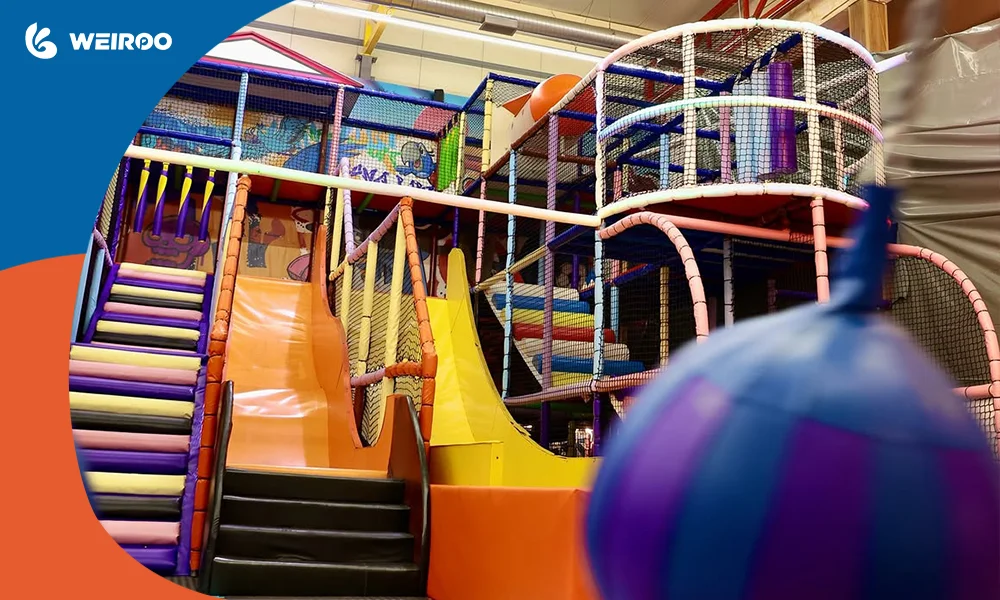
If you only have 200 to 300 sqm (2,000 – 3,000 sq. ft), or if you are a first-time entrepreneur looking to add a play area to a restaurant, Soft Play is your only rational choice.
Why? Because it is the low-risk “MVP” (Minimum Viable Product). It doesn’t require massive ceiling heights or complex civil engineering. It is born to fill fragmented spaces.
Trampoline Parks, on the other hand, are “Complexes.”
The successful trampoline parks I’ve seen are usually over 1,000 sqm (10,000 sq. ft). You have to zone out free jump areas, dodgeball courts, and usually squeeze in a Soft Play area anyway. If you force a few trampoline nets into a space smaller than 500 sqm, trust me, customers will walk in, look around, and think it looks “cheap.” You can’t justify a high ticket price with that.
The Brutal Reality of Cash Flow
Let’s talk money.
If you own the land and build a huge warehouse, sure, do a Trampoline Park. But for most clients renting a venue, Soft Play allows you to survive the “worst-case scenario.” Even if foot traffic is low for the first three months, your operating costs are controllable because the area is small, energy consumption is low, and you don’t need a heavy security staff.
But a Trampoline Park? It’s a cash-burning monster.
- You need more safety monitors (this is mandatory by regulation).
- You are paying rent on a massive footprint.
- You are paying higher AC and lighting bills.
I’ve seen many clients pick a huge venue and do a fancy fit-out, only to have their cash flow snap before the first 6 months were up. If you are new to this game, start with a Soft Play area. It’s not embarrassing; it’s smart.
2. Engineering & Compliance: The Hard Metrics That Can Shut You Down
What’s the worst case I’ve seen? A client signed the lease, paid the deposit, and even had the equipment shipped to the port. Then the local fire and safety inspector walked in, pointed at the ceiling, and said, “No.”
Game over.
The Ceiling Height “Death Line”
This is the first question I ask before giving a quote.
- Soft Play: Your ceiling only needs to be 2.9 meters (9.5 ft).
- Trampoline Park: This is a different game. I strongly recommend your ceiling be higher than 5.5 meters (18 ft).
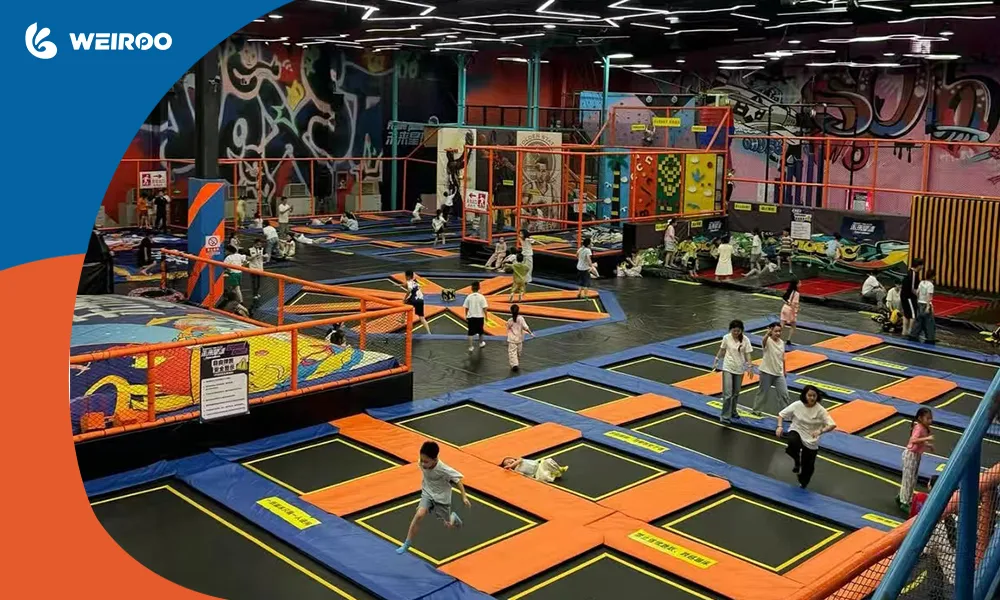
Why? It’s not just about kids hitting their heads. It is about passing local safety inspections. If your height is awkward (like exactly 5 meters), don’t guess. You need accurate trampoline park design information regarding clearance zones and structural loads before you commit to a lease.
The “Cheat Sheet” for Regulations
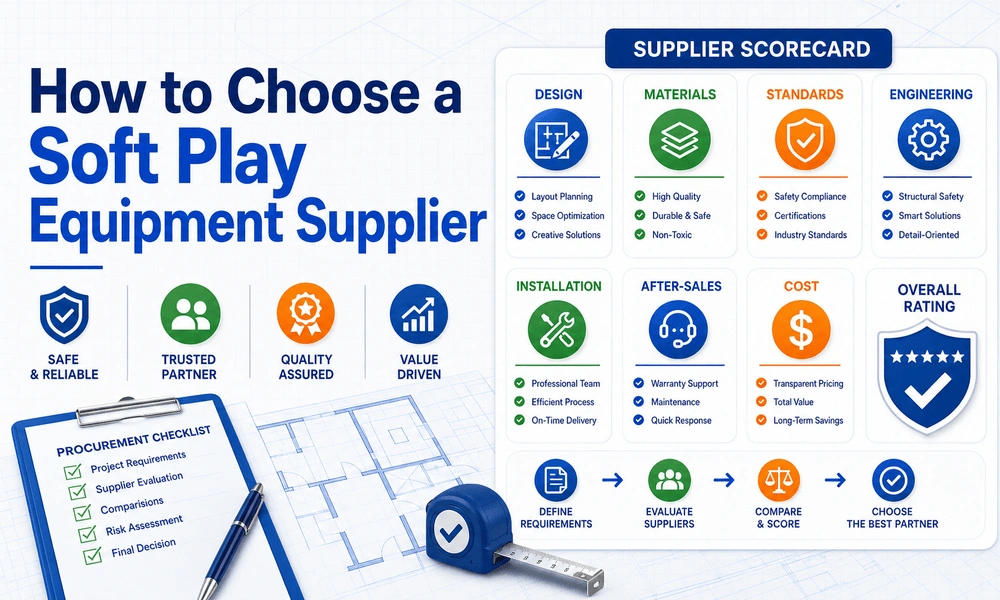
Don’t get fooled by suppliers who just say “we have high quality.” In this industry, “High Quality” means complying with specific code numbers, especially when you are importing soft play apparatus or trampoline kits from overseas.
If you are exporting to the US or Europe, save this list:
- North America:
- Soft Play: Must comply with ASTM F1918.
- Trampoline: Must comply with ASTM F2970.
- Europe:
- Soft Play: Must comply with EN 1176.
- Trampoline: Must comply with EN ISO 23659:2022.
If your supplier stammers and can’t show you these certificates, change suppliers immediately.
3. Hidden Costs: The Invisible “Profit Eaters”
Many people only look at the equipment purchase price, ignoring maintenance costs. As an exporter, let me tell you some secrets from the factory floor.
Don’t Let “White Board” Ruin Your Structure
You might not peel back the PVC vinyl to look at the wood inside, but I suggest you do. There is a detail that only factory masters know: “Red Board” vs. “White Board.”
- Red Board (Construction Grade Plywood): Its core advantage is hardness and stability. For all load-bearing platforms and standing areas, we must use Red Board. This ensures the wood won’t deform even after years of use.
- White Board (Standard Plywood): It is softer and has better flexibility/toughness. Therefore, it is best used for Shaping and Styling (like curved decorations or themed facades).
Where is the trap? Some factories, to save costs or because they don’t know better, will use White Board for your load-bearing platforms. It looks the same on Day 1. But after a few years of operation, the White Board edges will start to warp and collapse.
Remember my rule: Red Board for the Skeleton, White Board for the Style. Get this wrong, and your equipment’s lifespan is cut in half.
PU Leather is Beautiful, But Don’t Step on It
Pay attention to the cover material.
- PVC: Wear-resistant, tough. Any place where feet step or kids crawl must be wrapped in PVC.
- PU Leather: Bright colors, looks great, flexible. But it is only suitable for wrapping decoration faces.
If someone uses PU leather on a floor mat to save time, it will be worn through in less than a year.
The Hygiene Nightmare: The Ball Pit
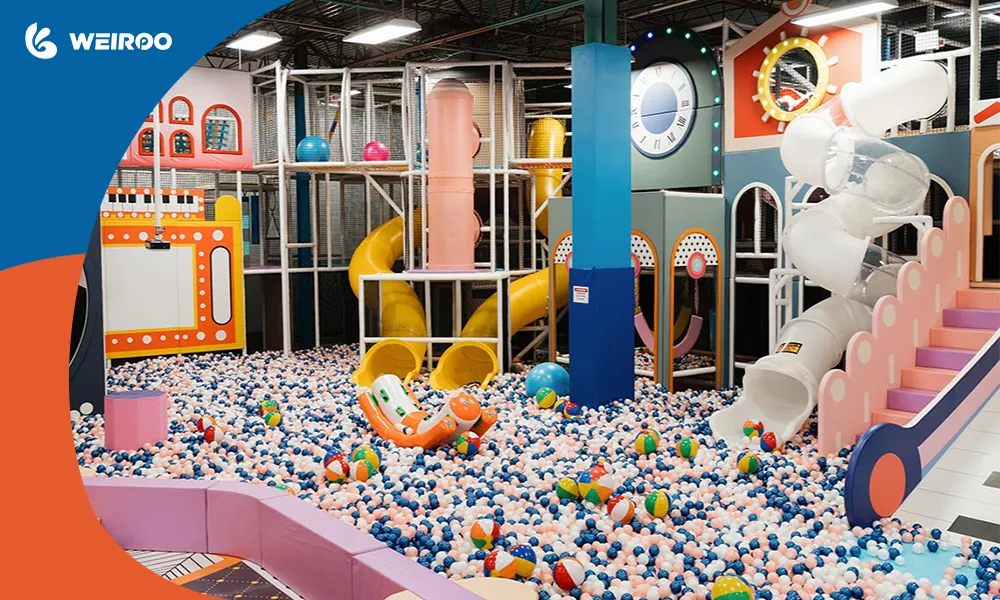
Regardless of which equipment you choose, you will likely have a ball pit. Here is my “counter-intuitive” advice: Include a “Ball Washing Machine” in your initial budget.
Do not count on manual cleaning. With thousands of balls, plus kids’ sweat and drool (or worse), the bottom of that pit gets disgusting. If you don’t clean it regularly, parents will smell the odor and never come back.
Trampoline “Life-Span Anxiety”
Although our trampolines use high-quality Manganese Steel Springs (trouble-free for 3 years), you have to accept a reality: The depreciation rate of a Trampoline Park is higher than Soft Play.
Because trampolines are used not just by toddlers, but by heavy teenagers and adults. Every jump wears down the equipment. If you choose trampolines, be mentally prepared: After 3 years of operation, you will face a significant renovation cost.
4. Profit Model: Why “Hybrid” is the Real Winner
We’ve talked about engineering; finally, let’s talk about making money.
Who is Paying You?
- Soft Play Logic: Your target is Toddlers (1-5 years old). This age group is “sticky.” If they come, the parents have to come. The ticket price might be lower than a trampoline park, but the repeat purchase rate is high.
- Trampoline Park Logic: Your target is Teens (12+) and adults. Explosive traffic, high ticket price, but fierce competition.
But to be honest, whatever equipment you choose, it’s just a “Traffic Driver.” The real “Cash Cow” is Birthday Parties.
When you can bring kids in for a birthday, driving food, beverage, and team-building revenue, that is where the profit lives. So, your design must reserve space for Party Rooms.
The Ultimate Advice: How to Spend Your $100k
Back to the original question: If you have $100k, what do you choose?
My advice: Don’t do a standalone Trampoline Park. A $100k trampoline park is too small. It gets boring quickly, and it’s hard to compete with big chains.
The current trend is the FEC (Family Entertainment Center) Hybrid Model:
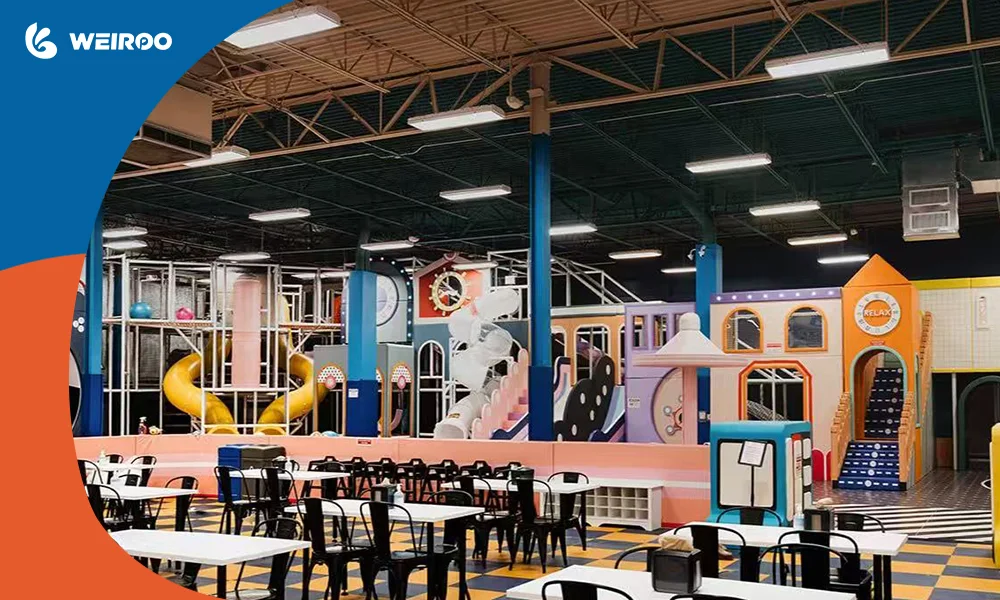
- Use Soft Play to fill the majority of the area at a low cost (as your base traffic pool).
- Add a few Trampoline attractions in the core area (as high-light features).
This “Soft + Trampoline” combo controls your budget while covering all age groups. It is the model with the fastest ROI I see right now.
Conclusion: Honest Words for Future Owners
After 10 years of exporting, my biggest realization is this: Equipment can be shipped from China, but I can’t fix your bad location choice.
If you are still hesitating, take one step first:
Send me your Floor Plan.
Tell me your budget, and I will tell you if that space is suitable for a boutique Soft Play, or if the neighborhood is screaming for a Hybrid FEC.
I would rather you ask me hard questions now than have me ship you spare parts to fix warped wood two years later.
Chat soon.
FAQ: Questions My Sales Team Hears Every Day
Q1: Which business is harder to get insurance for?
(Soft Play vs. Trampoline) Trampoline parks will almost always suffer from significantly higher liability insurance premiums than Soft Play centers. Expert Insight: In the eyes of an insurance underwriter, a Soft Play structure is a “low-speed environment,” while a Trampoline Park is classified as an “extreme sport.” In my experience exporting to the US and UK, trampoline owners often face premiums that are 3x to 5x higher. If you are on a tight budget, call a local insurance broker before you call me to buy equipment.
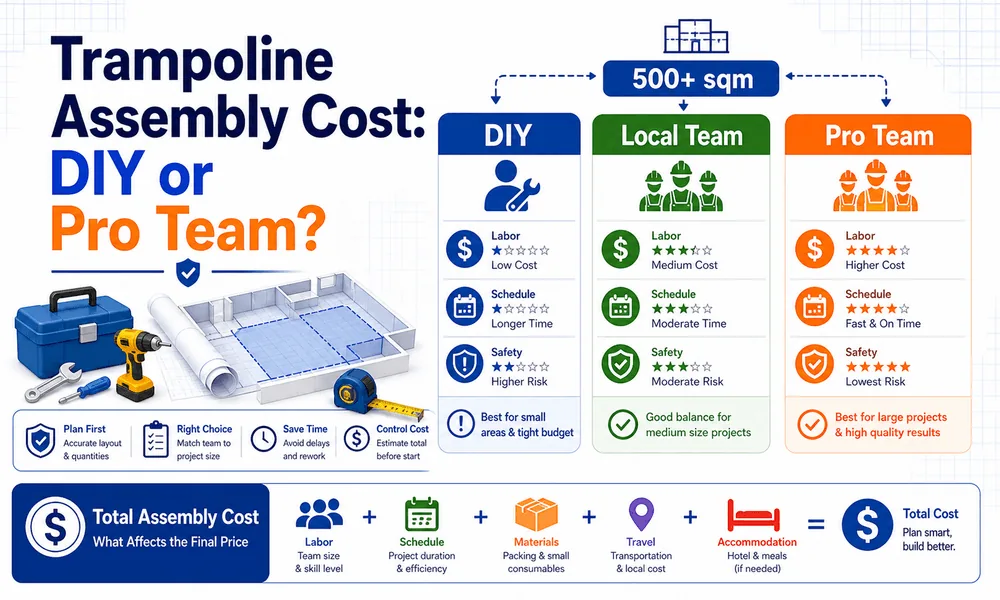
Q2: Can I install the equipment myself to save $15,000?
You might survive installing a small Soft Play structure yourself, but do not attempt a DIY installation for a Trampoline Park. Expert Insight: Soft Play is essentially “Adult LEGOs”—fastening pipes and clamps. It’s tedious, but doable with a few guys and a scaffold. However, Trampoline Parks involve tensioning thousands of springs and ensuring the frame structure can withstand massive dynamic loads. If you install it wrong and a frame snaps, no manufacturer warranty will save you from the lawsuit.
Q3: Which equipment has a better resale value if I close down?
Trampoline frames are easier to resell because they are modular, whereas Soft Play is often “custom-cut” for a specific room. Expert Insight: A trampoline frame is made of standard 5x5m or 3x3m steel grids that can be disassembled and moved to any warehouse. Soft Play, however, is designed around your specific columns and ceiling heights. Selling a used Soft Play structure is like trying to sell a used tailored suit—it rarely fits the next guy perfectly.
Q4: Is it true that Soft Play is only for babies?
No, modern Soft Play (Indoor Playground) structures are now being designed with “Ninja Course” elements to attract older kids (6-12 years). Expert Insight: The old-school “ball pit and slide” is indeed for toddlers. But recently, we have been integrating “Tag Arenas” and multi-level obstacle courses into Soft Play structures. This allows you to extend your customer age range without taking on the high risks and insurance costs of a full Trampoline Park.