My Client Doubled Their Revenue in Month One. Here’s How.
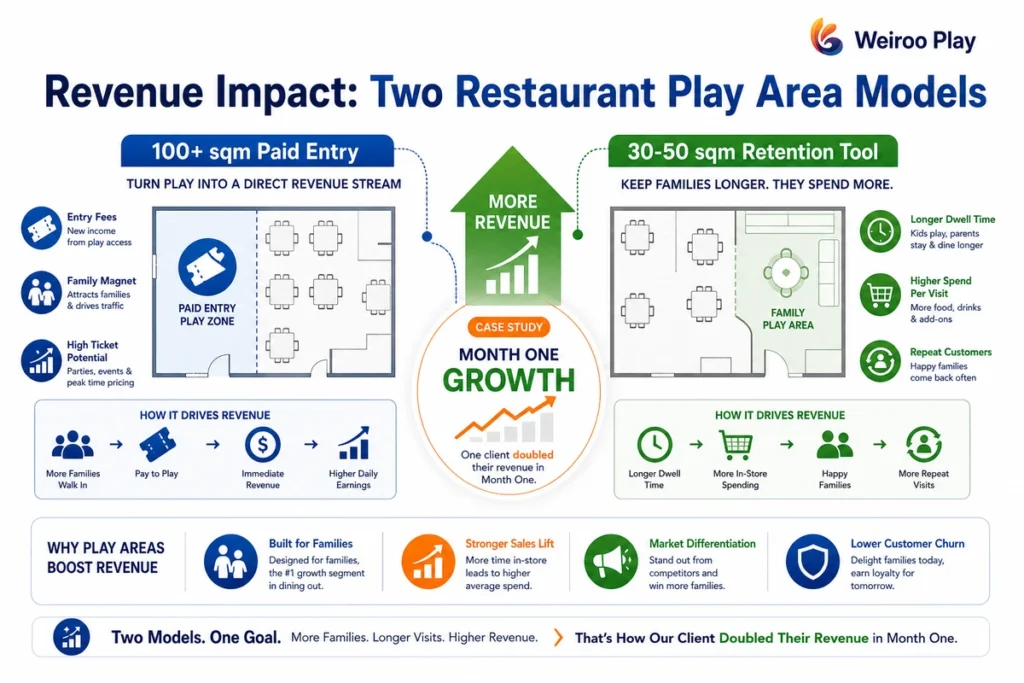
I have a client – a mid-size restaurant chain in Southeast Asia – who added a play area to one of their locations and saw revenue double in the first month. No marketing campaign, no discount promotions, no special event. Just a play zone that their customers had been asking for.
But that’s not a guarantee. Not every restaurant that adds a play area sees results like that.
I’ve seen two very different situations, and the difference comes down to space – and more importantly, positioning.
Situation one: The restaurant has enough total space to carve out 100+ sqm (1070+ sq ft) for a dedicated play zone. This configuration supports a paid-entry model. Parents pay a fee to let their kids play, and the restaurant becomes a one-stop destination for dining with kids. Doubling revenue in month one isn’t rare in this setup – because the demand from parents for exactly this kind of space is real, and it’s frequent in markets across Asia, Middle East, and growing European family dining scenes.
Situation two: Total space is limited, only 30-50 sqm (320-540 sq ft) can be allocated. This area can’t support a paid-entry model, but the growth is still meaningful – because it solves two persistent restaurant problems: waiting customers and kids who can’t sit still. Parents bring their kids, the kids have somewhere to play, and the adults can actually finish their meal. Growth isn’t necessarily doubled revenue, but repeat visit rates and positive reviews go up noticeably.
The shared logic behind both: the play area doesn’t solve “one more revenue stream.” It solves “keep the customers who would have otherwise walked out, and make them want to come back.”
You Might Be Underestimating Your Own Judgment
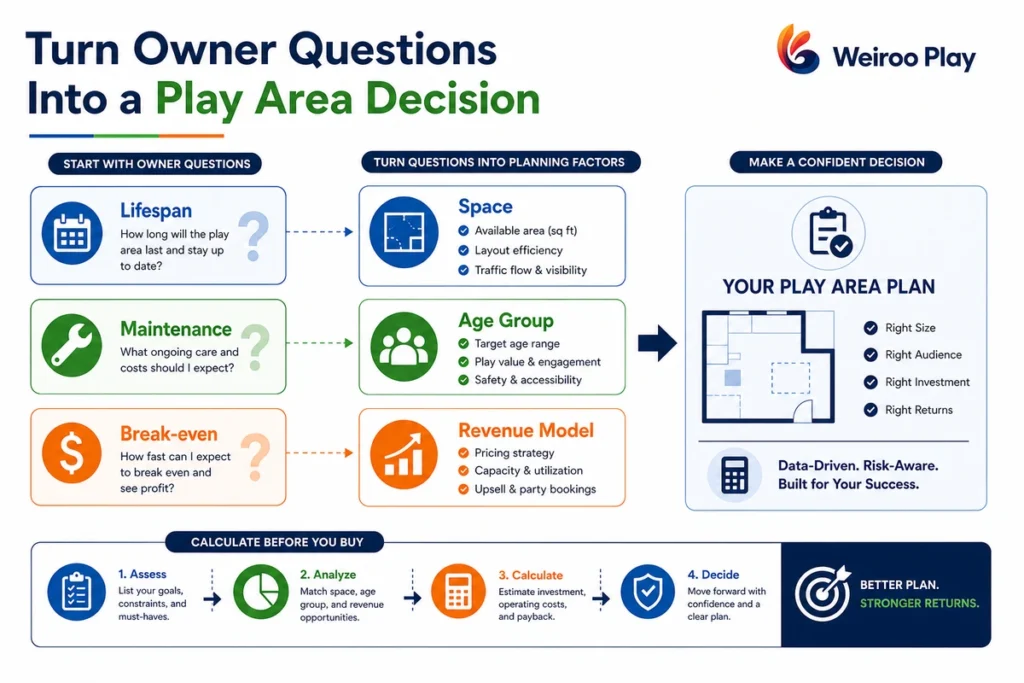
Most restaurant and cafe owners who come to me to talk about this have actually thought it through pretty clearly. The questions they ask are practical: How many years is the equipment lifespan? What are the maintenance costs? How long does it take for my type of restaurant to break even?
They’re not confused. They just need someone to help them turn scattered thoughts into something they can actually calculate. A salesperson can show you a deck, but nobody’s going to tell you how this type of restaurant usually works out the math.
This article is here to solve that. No concepts, just how to calculate the numbers, how to avoid the pitfalls, how to know if you’re a good fit. After reading this, you’ll have a clear picture before you talk to any supplier.
The Most Common Mistake in This Space: Getting the Target Audience Wrong
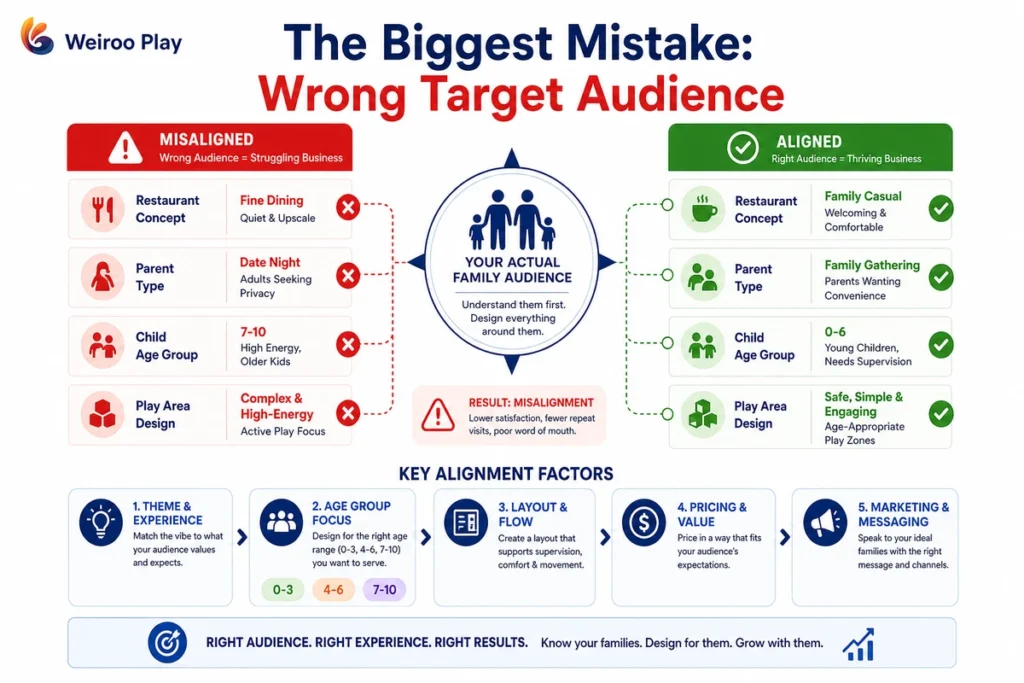
This is something I only see when I’m on-site, and it’s the mistake I’ve watched clients make more than once – and the equipment supplier usually disappears after the sale.
The most typical scenario: a restaurant with decor and style aimed at young urban professionals in their 20s and 30s. That demographic largely doesn’t have kids yet, or their children are very young. The play area gets built, but the crowd that shows up has nothing in common with the restaurant’s core customer base. Parents find it too noisy and crowded, kids find the equipment not age-appropriate. Neither side is satisfied. If you’re working with commercial playground equipment companies on this, make sure they’re helping you think through target audience, not just selling you equipment.
This isn’t an equipment problem. It’s a positioning problem. Before you decide to add a play area, ask yourself: what kind of family is this restaurant actually serving? Families with pre-schoolers? Infants? Older kids above primary school age? Your theme and equipment should follow the crowd, not the other way around.
Once this positioning direction is locked in, your pricing selection, space layout, and marketing copy all align accordingly. Inconsistent direction means every subsequent investment gets discounted.
Two Business Models, Two Space Requirements – Know Which One You’re Building
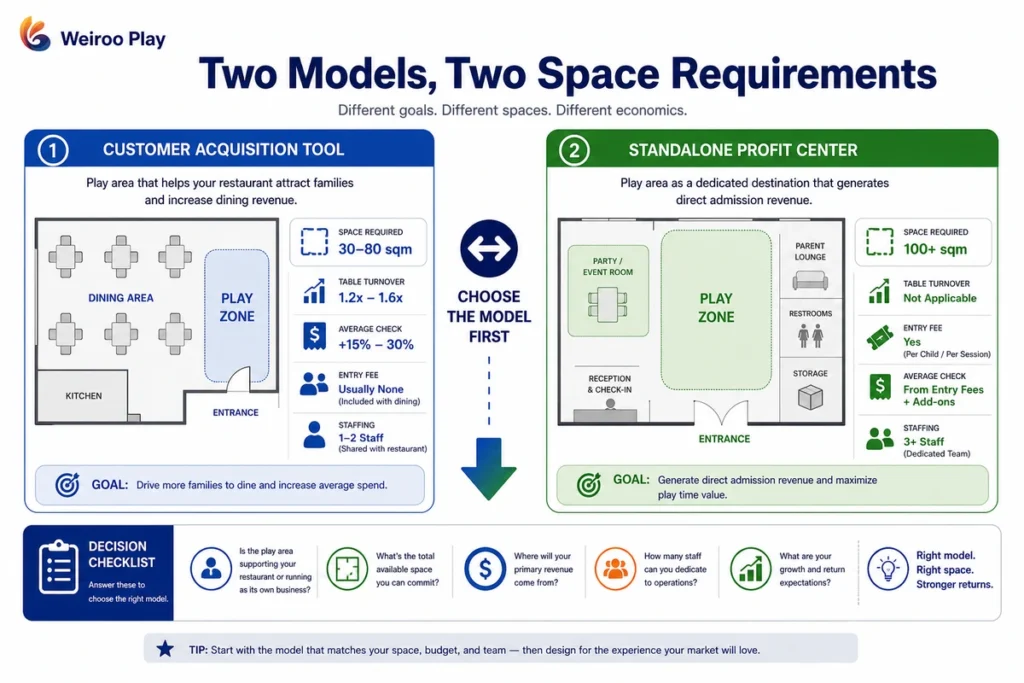
Your positioning determines what kind of business you’re actually running.
Some restaurants use the play area as a customer acquisition tool – the play zone attracts families, and the food service itself is the profit center. The play area pays for itself through increased table turnover and higher average check size, not through direct play fees.
Others run the play area as a standalone profit center – parents pay an entry fee, and food and beverage is supplementary. This model requires more space (100+ sqm / 1070+ sq ft minimum for paid entry to make sense) and dedicated staffing. The revenue math is different from the first model, and so is the investment threshold.
The mistake I see constantly: owners use data from one model to evaluate the viability of the other. They look at a paid-entry playground’s revenue per square meter and try to apply it to a 40-sqm retention tool. These are two different businesses. Knowing which one you’re building matters more than knowing the numbers from someone else’s setup.
What Equipment Actually Works in a Restaurant Context
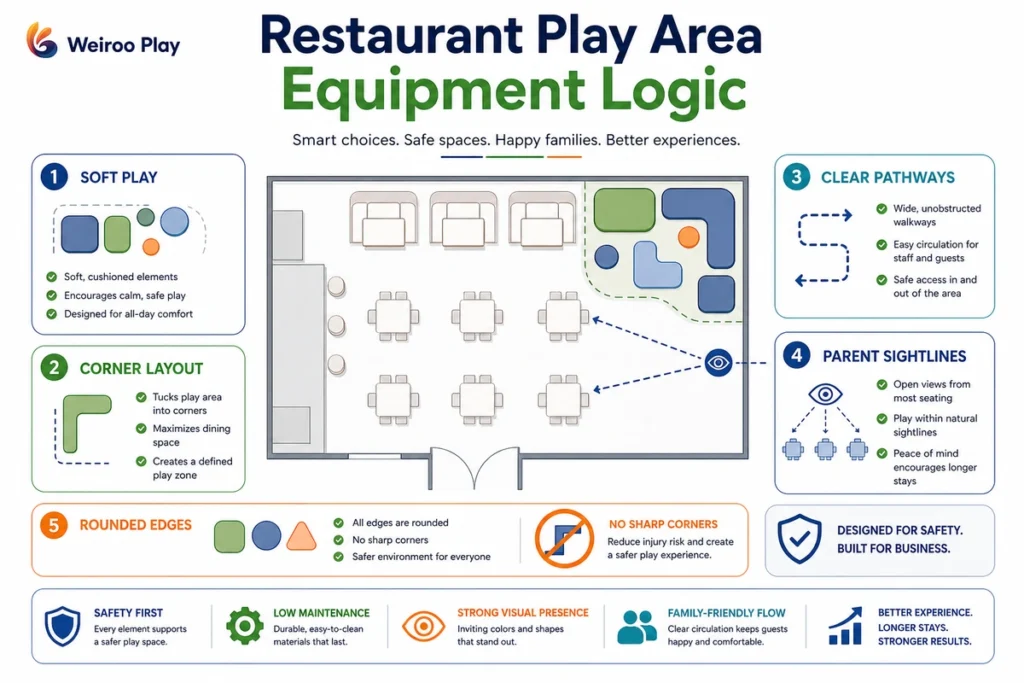
The equipment logic for a restaurant play area is different from a dedicated indoor playground. What you need is something that creates a strong visual presence without consuming all your available space. Soft play is the default recommendation for restaurant contexts – high safety factor, low maintenance, and high parent acceptance. Combination climbing frames and slides work well along walls or in corners, with clear pathways maintained in the center.
One practical constraint that many owners overlook: sharp corners and right-angle equipment designs are genuinely dangerous in a restaurant environment where children are running. The liability implications alone should make this a serious consideration during equipment selection. A good supplier will flag this in their layout proposal – if they’re not raising it, they’re either inexperienced with restaurant installations or they just want to move inventory.
Before you sign a purchase agreement, ask your supplier for a scaled floor plan based on your actual restaurant layout. They should be able to show you equipment placement, egress paths, and sight lines from the dining area. If they can’t, that’s a reason to slow down.
300 Square Meters Is the Sweet Spot – But Smaller Spaces Have Options Too
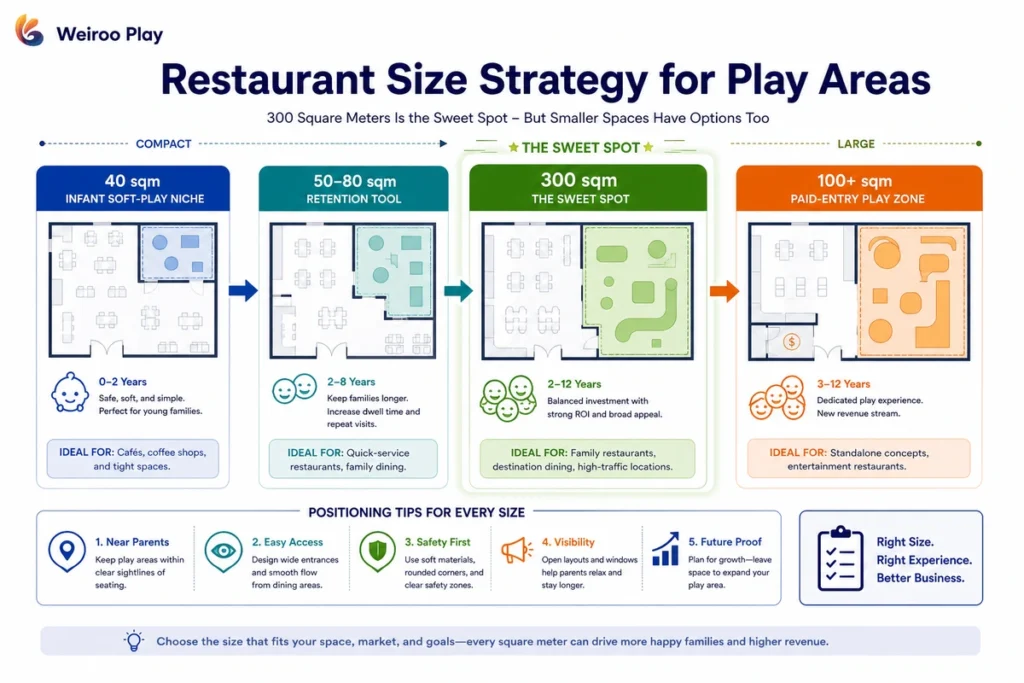
If you ask me what size restaurant is best suited for adding a play area, my answer is around 300 sqm (3200 sq ft) in total restaurant space.
Restaurants at this scale typically have enough spatial flexibility to designate a section for an experience zone without significantly impacting seating capacity. Above 100 sqm (1070 sq ft), you can build a standalone paid-entry play area and the business model works. If you only have 50-80 sqm (540-860 sq ft), you can still do it – but adjust your expectations from “standalone profit center” to “customer retention tool.” Even a compact setup with quality indoor play structures can meaningfully improve the dining experience for families.
When space is limited, the positioning needs to be more precise. I’ve seen a really good example: a restaurant in a busy commercial district turned their limited 40-sqm area into a dedicated infant soft-play zone, serving families with babies under three. This positioning seems narrow, but actually there’s less competition and higher loyalty. Families with infants eat out very frequently but have very few suitable places to go – once your restaurant solves that problem, their repeat visit rate is remarkable. In markets across the Middle East and Southeast Asia, this positioning has consistently outperformed broader “family restaurant” positioning in terms of revenue per square meter.
This isn’t about who has more space. It’s about who has more precision in their positioning.
The Real Payback Math Doesn’t Start With Equipment Cost
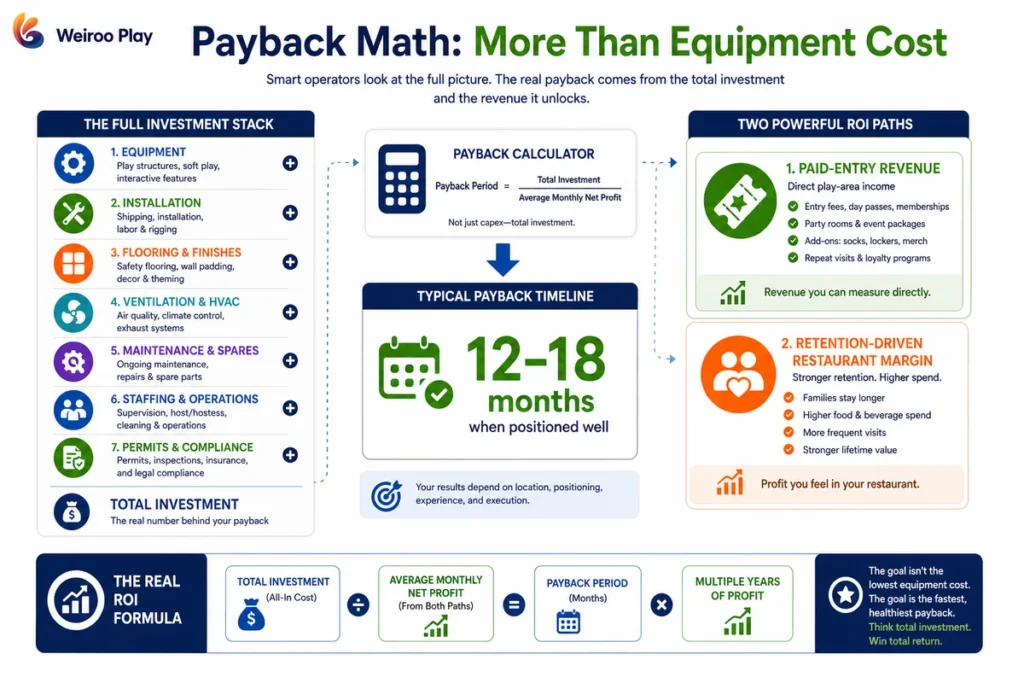
When owners ask me about payback period, the first thing I tell them is that equipment cost is probably the smallest number in their actual calculation.
Here is what actually goes into the payback math: equipment purchase and installation, any structural modifications to your space (ventilation, flooring, safety surfacing), ongoing maintenance, staffing for zones above 80 sqm, and potential licensing or compliance costs in your local market.
A standalone paid-entry play area in a high-traffic location, with proper pricing (typically $8-20 per child per session depending on the market), can break even in 12-18 months if positioned and managed correctly. But if your play area is a retention tool embedded in your dining experience – where the revenue shows up in higher check sizes and repeat visits rather than direct play fees – you need to calculate it differently. The payback shows up in your overall restaurant margin, not in a separate play area P&L.
Ask any supplier who leads with equipment price before they’ve asked about your space, your target age group, and your revenue model. That conversation tells you everything about whether they’re actually trying to help you solve the problem, or just move product.
Three Things to Figure Out Before You Talk to Any Equipment Supplier
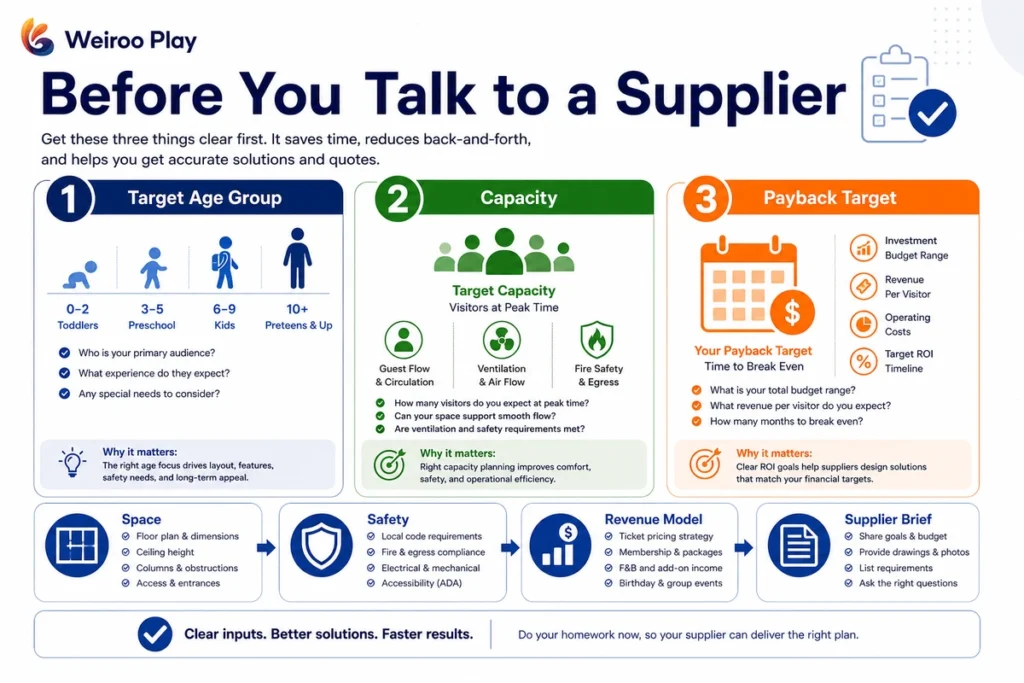
Before you contact any playground equipment supplier, get these three things clear:
First, what age group is your target children? Infant zones for 0-3 year olds and comprehensive play areas for 4-10 year olds require completely different equipment configurations. Choosing the wrong type means high retrofit costs later. If you’re building for infants, the safety requirements and equipment standards are materially different – this isn’t a place to cut costs based on price alone.
Second, how many children can your space accommodate at once? This determines your ventilation requirements, fire safety configuration, and maximum daily foot traffic capacity. A lot of restaurant owners underestimate this, resulting in overcrowding during peak hours and poor experience that shows up as negative reviews, not just underutilized equipment. When you’re mapping out your floor plan, make sure to account for the indoor playground space and height requirementsthat apply to commercial installations – even in a restaurant context, the safety margins matter.
Third, what is your payback period target in months? As a standalone paid-entry project, a well-located and well-operated play area can break even in 12-18 months. But if you’re treating it as a customer retention tool, the payback calculation needs to be redone – you can’t use the same logic to explain it to the owner, and you can’t evaluate it with the same metrics.
Frequently Asked Questions
Will adding a play area disrupt the normal dining experience?
It depends on your space layout and traffic flow design. Well-executed examples place the play area in a relatively independent corner, with visual barriers but not in the center of the dining area. Parents can hear their children without being overwhelmed by noise. Equipment selection should also avoid products that generate high-pitched sounds. With enough space, zoned design can simultaneously satisfy parents with kids and other dining guests. If you’re considering this alongside a broader indoor playground setup, it’s worth mapping out your floor plan early – our guide on indoor playground space and height requirements covers the layout principles that apply here too.
My restaurant is under 50 sqm – is adding a play area even meaningful?
Yes, but adjust your expectations from profit center to retention tool. You can place a few small soft-play pieces, mainly solving the “kids can’t sit still during meals” pain point. In this scenario, paid-entry isn’t recommended – it’s better as part of a meal package or membership benefit, making parents feel the dining experience is more complete when they visit your restaurant. When you’re mapping out a small space, think about how to plan the layout even with constrained square footage.
Are restaurant play area maintenance costs high?
Compared to the restaurant’s own operating costs, play area maintenance isn’t significant. Mainly daily cleaning, regular safety fastener inspections, and soft equipment sanitizing. Equipment quality matters a lot here – quality branded products basically have zero maintenance costs in the first two years, while inferior products can start having problems within three months. Maintenance costs are largely determined at the procurement stage – don’t cut corners on equipment.
Do I need dedicated staff to supervise the play area?
Play areas under 50 sqm typically don’t require full-time staff, but restaurant servers need basic safety training to know how to handle emergencies. For standalone paid-entry zones over 100 sqm, I recommend one dedicated supervisor – not just watching kids’ safety, but also maintaining order and handling parent inquiries. This cost needs to be factored into your payback period calculation.
Does a restaurant play area require any additional licenses or permits?
This depends on your country/region and the scale and nature of your play area. Generally, children’s entertainment zones for recreation purposes don’t require a separate entertainment business license in most regions. However, soft-play areas targeting children under 3 years old have higher requirements in some areas. Confirm with your local fire department and commerce department before purchasing equipment to avoid compliance issues after opening. If you’re navigating the regulatory landscape for the first time, it’s worth getting familiar with the ROI framework for indoor playground investments before committing to a specific setup.