Start With the Parts That Can Stop the Opening
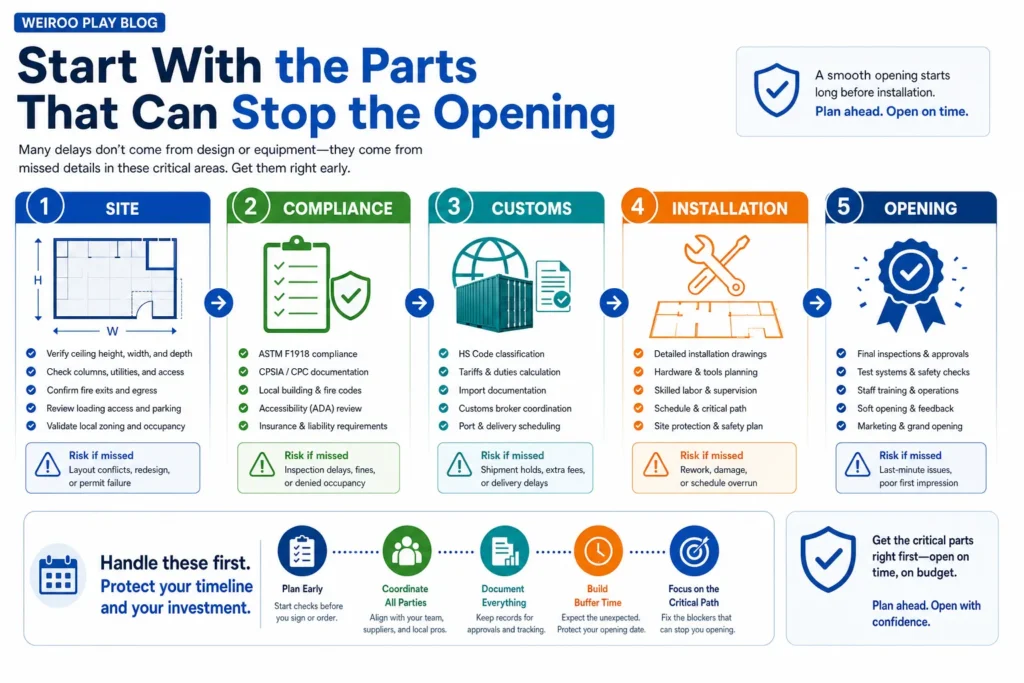
When buyers ask how to open an indoor playground in USA, many of them want to begin with equipment price, theme, or the 3D rendering. I understand that, because those are the parts you can see.
But in the US market, the things you cannot see on the first rendering often matter more: ASTM expectations, local fire access, insurance questions, customs documents, installation planning, and whether the building can actually support the design.
For first-time owners, the difficult part is that these decisions are connected. A supplier who does not understand ASTM F1918, soft contained play structures, fire routes, or installation sequencing may still produce a nice-looking design. The problem appears later, when the local inspector, landlord, insurance broker, or installation team starts asking practical questions.
That is why I would not treat a US indoor playground as a simple equipment purchase. It is a project. The design, documents, shipping, installation, and opening operation all need to match the American market.
Understand ASTM F1918 and Local Requirements Early
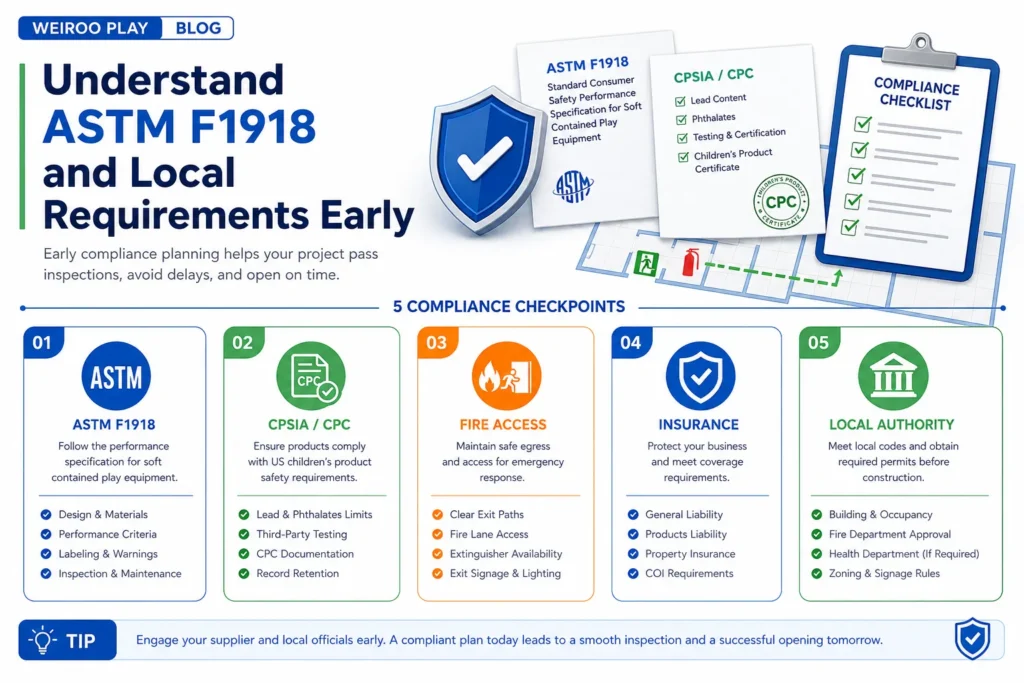
For soft contained play equipment in the United States, ASTM F1918 is one of the most important standards to discuss with your supplier. It is not something I would leave until the end of the design.
ASTM F1918 affects the way experienced manufacturers think about enclosed play structures, protection, use zones, access, and the way children move through the equipment. It also gives you a better language for talking with landlords, inspectors, insurance brokers, and project partners.
Here is the practical problem: first-time owners usually do not know what to ask for, so they rely heavily on the manufacturer. If the manufacturer has limited experience with US projects, the customer may not discover the weak points until the site is close to opening.
That is the wrong time to learn that a fire route is blocked, a height does not make sense, or a document is missing.
Some states, ports, brokers, or project situations may also involve CPSIA-related documentation, including Children’s Product Certificate requirements for products intended for children. You should confirm the exact requirements with your customs broker, local authority, and insurance provider before production, not after the goods arrive.
My suggestion is simple: ask about ASTM F1918, CPSIA/CPC documentation, local fire access, and insurance expectations during the design stage. If a supplier cannot have that conversation clearly, be careful.
Check the Site Before You Sign the Lease
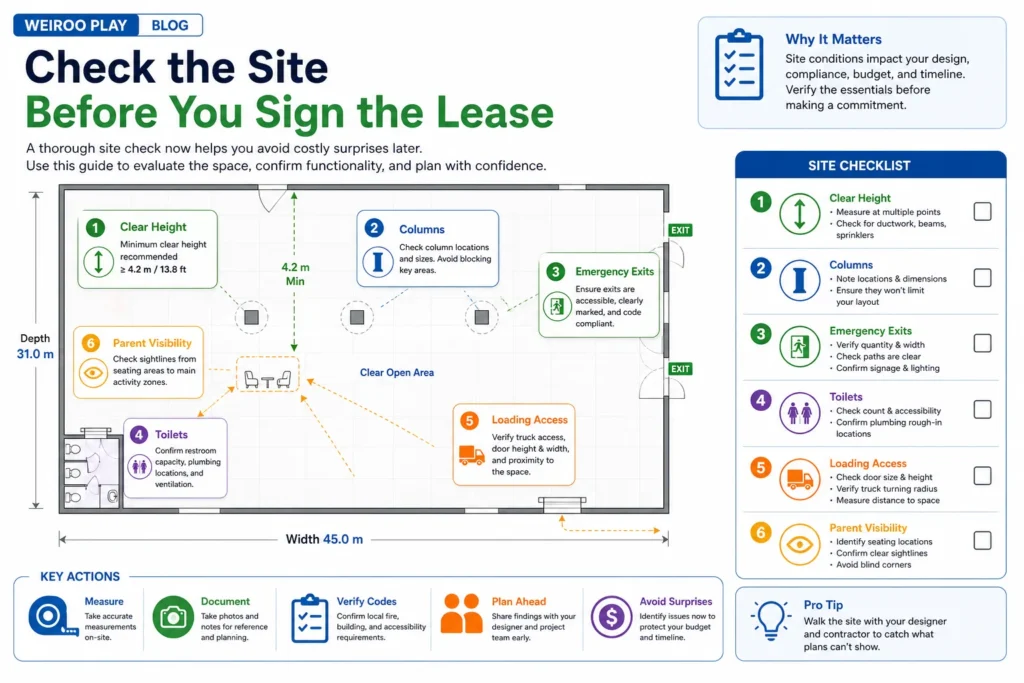
If you are still looking for a location, talk to your supplier before you sign. It is much easier to avoid a bad site than to rescue one after rent has started.
For a US indoor playground, I want to see the floor plan, clear ceiling height, column positions, emergency exits, entrance location, toilet location, loading route, and any landlord restrictions. These details decide what kind of equipment can be designed safely.
Height is especially important. A space may look large in square meters, but if the clear height is limited, you cannot simply add taller play structures or large trampoline areas and hope the experience still works.
One common mistake is assuming that open space means design freedom. In reality, the building decides many things before the designer even starts. Fire exits must remain accessible. Circulation must stay comfortable. Parents need visibility. Staff need to supervise. Installation teams need access.
If you are still comparing buildings, our guide to ceiling height and space requirements is useful before you commit to a lease.
A 990 sqm US Project With a 4-Meter Height Limit
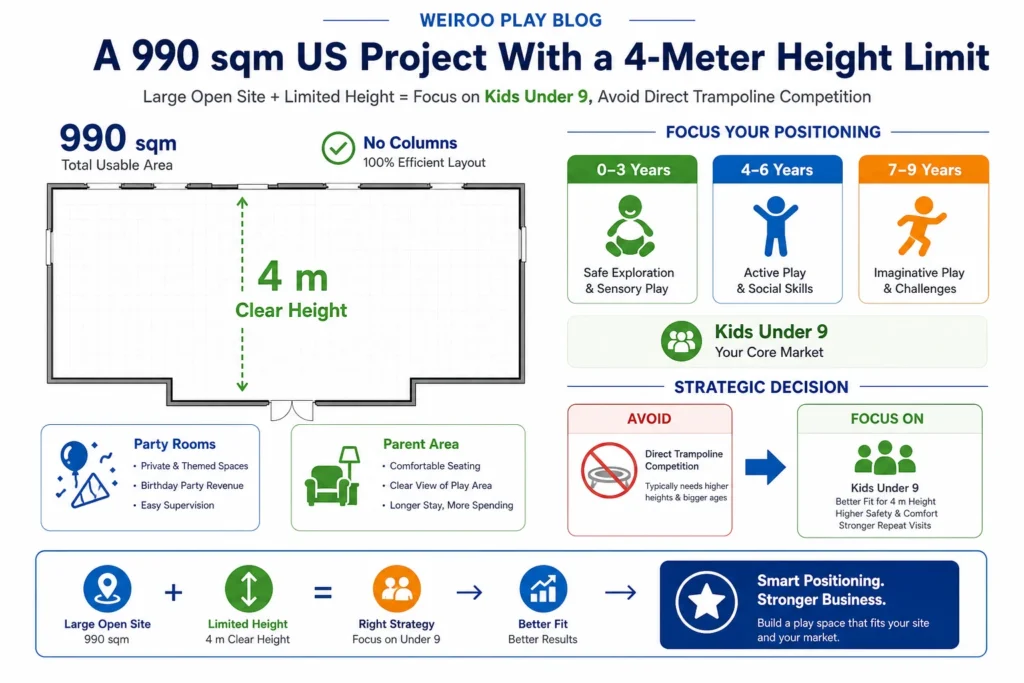
One US project I remember clearly had a 990 sqm site with no columns. On paper, it looked almost perfect. The space was wide, open, and easy to imagine as a large family entertainment venue.
But the clear height was only about 4 meters.
That detail changed the whole strategy. Under US project expectations and ASTM thinking, the height was not suitable for a large trampoline park or many attractions aimed at older children. The client knew he wanted an indoor playground, but he was not yet clear about the best customer group.
Instead of forcing a design that competed directly with trampoline parks, we suggested a sharper position: build the largest local play center focused on children under 9.
That decision made the project stronger. The site could support a rich soft play layout, younger-child activities, party rooms, and parent areas without pretending to be a high-challenge park for older kids. It also helped the client avoid direct competition with trampoline parks nearby.
This is the kind of decision a manufacturer should help you make. Good design is not only about fitting more equipment into the room. It is about choosing the right business for the building you actually have.
What US Families Often Care About
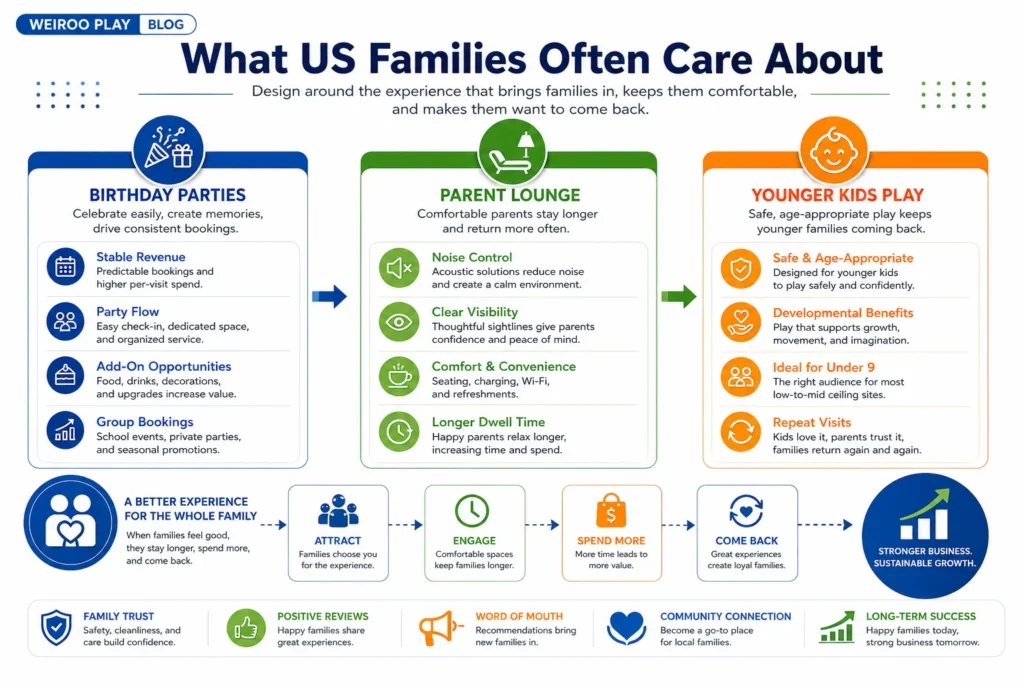
From our experience, the US market has two areas that deserve more attention than many first-time owners give them: birthday parties and the parent experience.
Birthday parties are not a small side business. In many indoor playgrounds, they become one of the most stable revenue sources. If you want that income, the layout has to support it from the beginning.
Party rooms need a reasonable location. Staff need a cleaning route. Parents need a place to wait. Food, gifts, decorations, and extra guests all create pressure if the plan is too tight.
The second issue is the parent resting area. Many owners who have already opened later tell us the same thing: parents bring children to play, sit down with coffee, and still cannot relax because the surrounding noise is too loud.
This matters because parents are the paying customers.
If you are planning a US indoor playground, consider using sound-reducing glass or a quieter parent lounge design. The goal is not to separate parents completely from the play area. The goal is to reduce noise while still letting parents watch their children comfortably.
For many US projects, the winning combination is not always the most extreme attraction mix. It may be strong soft indoor playground equipment, party rooms, a clean toddler zone, a good parent lounge, and a layout that feels easy to use on weekends.
Budget for HS Code, Tariffs, Freight, and Installation
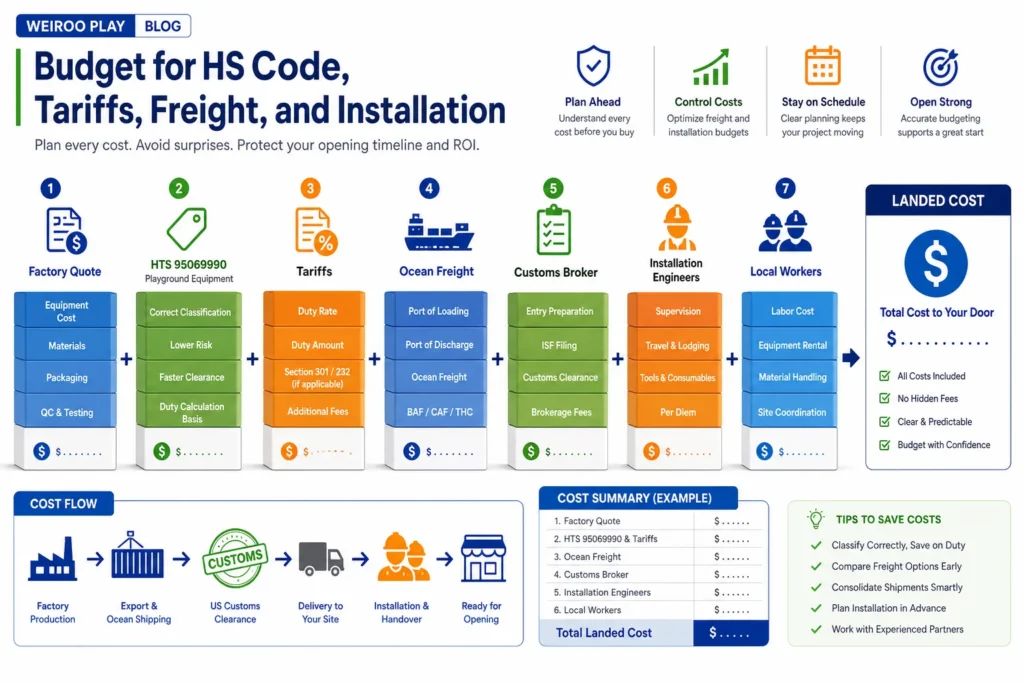
For imported indoor playground equipment, US buyers should not stop at the factory quote. The landed cost matters more.
For our product category, we commonly use HS/HTS code 95069990, but you should confirm the classification and tariff treatment with your customs broker before importing. Tariffs are part of the purchase cost, and in some countries certain import taxes may be handled against later business taxes, but that depends on local tax rules and professional advice.
Freight is another moving number. Ocean freight changes by route, season, container volume, and timing. A quote that looks safe in one month may not be the same later.
Installation is the cost many owners underestimate most. Larger projects take time, and US local labor is not cheap. Our usual solution is to send one or more Weiroo installation engineers or team members to guide the installation while the client hires local workers to assist.
This is often the most cost-effective arrangement. It avoids sending a full overseas team, but it still gives the site professional direction from people who understand the equipment structure.
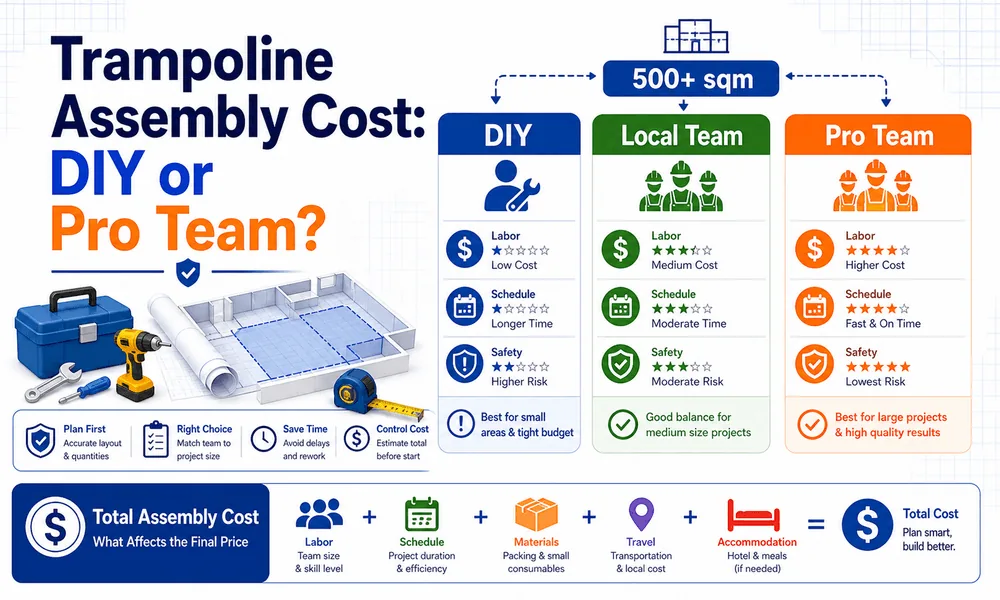
Clients should budget for round-trip flights, accommodation, local transport, meals, and daily wages. Our installation wage reference is about $150 per person per day, depending on the final arrangement. This needs to be planned before shipping, not after the containers arrive.
If you are new to importing, read our guide on importing playground equipment from China before you compare quotes, and review CBP’s basic importing guidance for the US import process.
Why Engineering Breakdown Is a Real Advantage
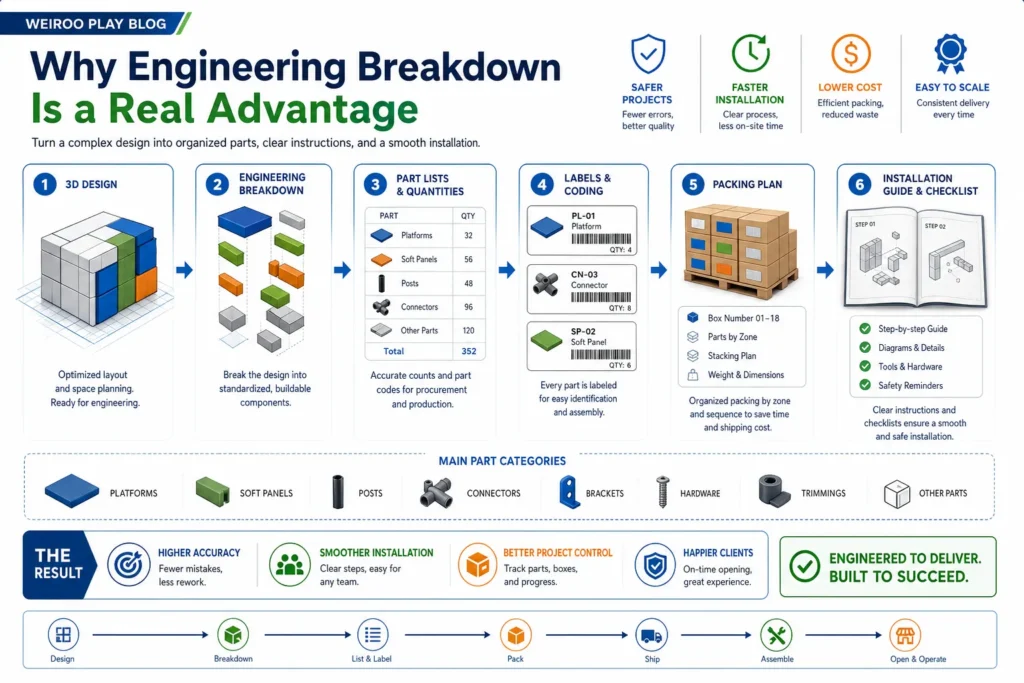
Indoor playground equipment is not shipped as one finished object. It must be broken down into parts that can be manufactured, packed, shipped, identified, and assembled on site.
This is where engineering breakdown matters.
Not every manufacturer has a dedicated engineering breakdown team. In our view, this is one of the differences between a factory that can make play equipment and a supplier that can support an overseas commercial project.
Before production, the structure needs to be converted into practical manufacturing and installation information. Platforms, soft panels, posts, nets, slides, connectors, foam parts, and labels need to match the drawing and the packing plan.
If this work is weak, the installation team loses time on site. Parts become hard to identify. Local workers wait for instructions. The project schedule gets pressured.
Weiroo has an engineering breakdown team plus an installation team that works across different countries. That combination helps reduce installation confusion, especially for US projects where labor cost, schedule pressure, and inspection timing all matter.
A good soft play supplier should help you long before production starts and stay involved until the site can actually install smoothly.
Design Around Parents, Not Only Children
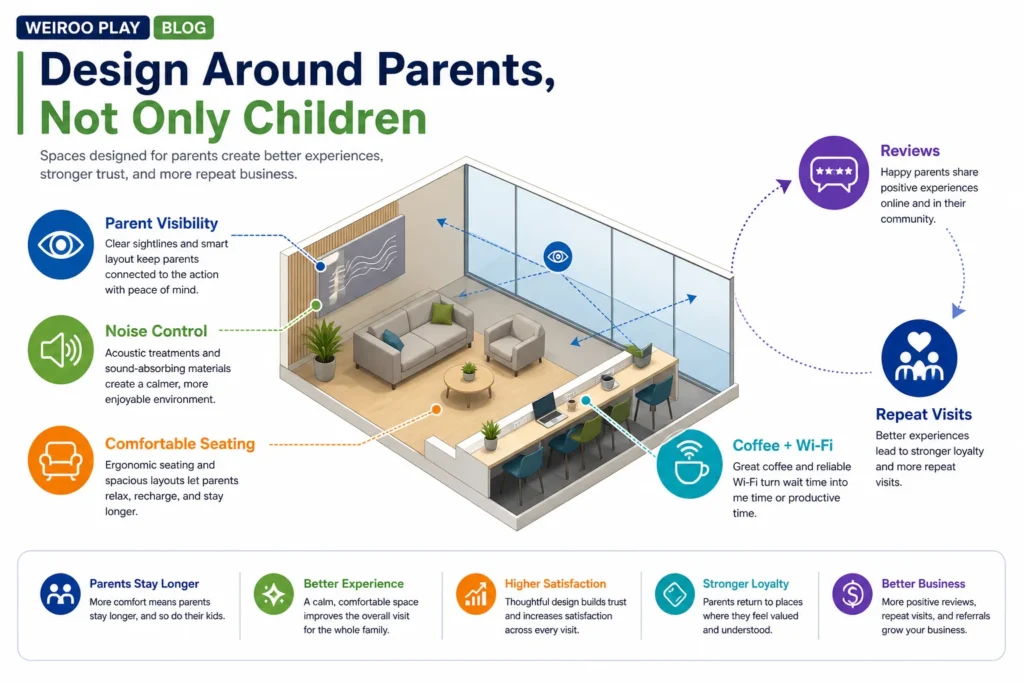
A common design mistake is treating the playground as if only children matter. Of course children must love the space, but parents decide whether the family returns.
In the US market, the parent experience can affect membership, birthday party bookings, reviews, and repeat visits. If parents cannot see their children, cannot sit comfortably, or cannot hear themselves think, the visit becomes tiring.
That is why I like parent areas that are visible, quieter, and close enough to the play zones without being trapped inside the noise.
Sound-reducing glass can be a smart investment in some venues. It lets parents keep visual contact with the play area while reducing noise enough for coffee, work, or conversation.
This detail may sound small during design, but owners often understand its value only after opening. Parents are not just companions. They are the customers paying for the experience.
Do Not Compete With Trampoline Parks Unless the Site Supports It
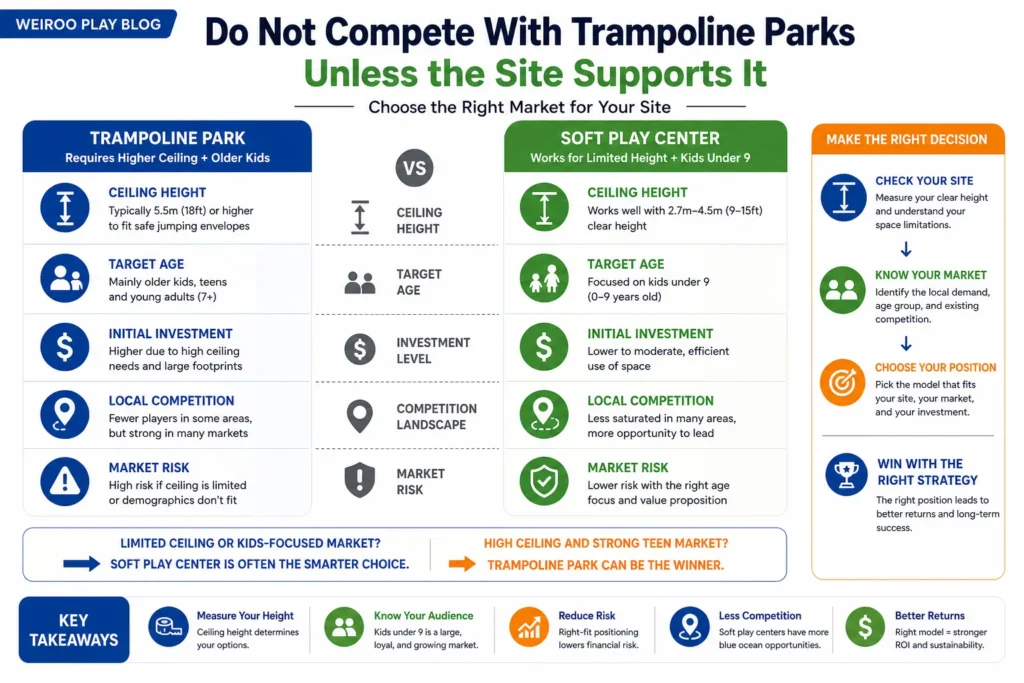
Many US cities already have trampoline parks or larger family entertainment centers. Competing with them directly is not always the best strategy.
If your ceiling height, budget, insurance situation, or target market does not support a large trampoline park, forcing that direction can weaken the project.
The better move may be to build a cleaner, safer, more focused indoor playground for younger children, especially if local competitors are built around older kids and high-energy attractions.
The 990 sqm project is a good example. The site was large but not tall, so the smarter strategy was not to imitate a trampoline park. It was to become the strongest local destination for children under 9.
This kind of positioning can make marketing clearer, equipment selection easier, and birthday party planning more focused.
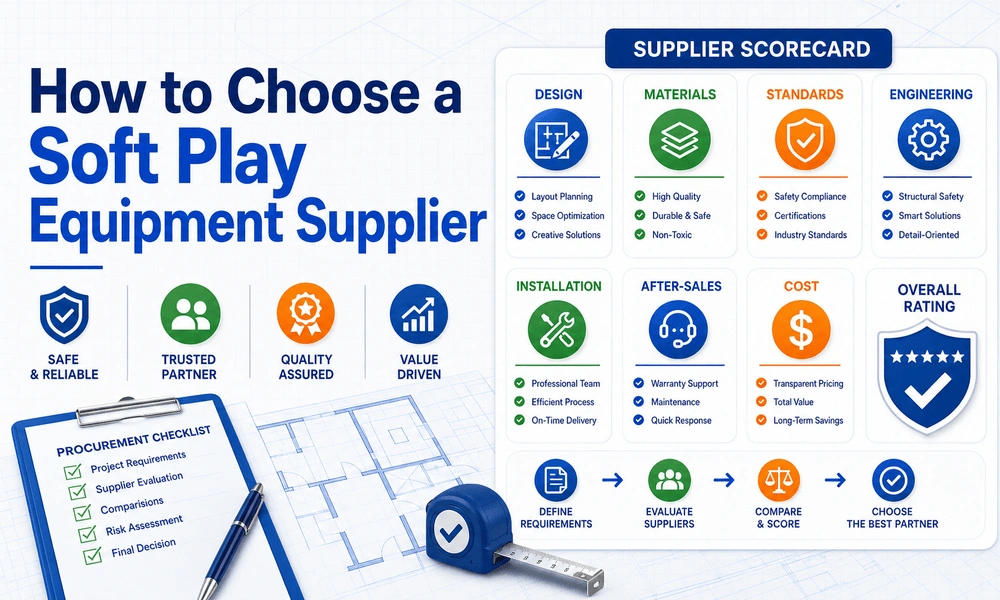
Choose a Supplier Who Understands US Projects
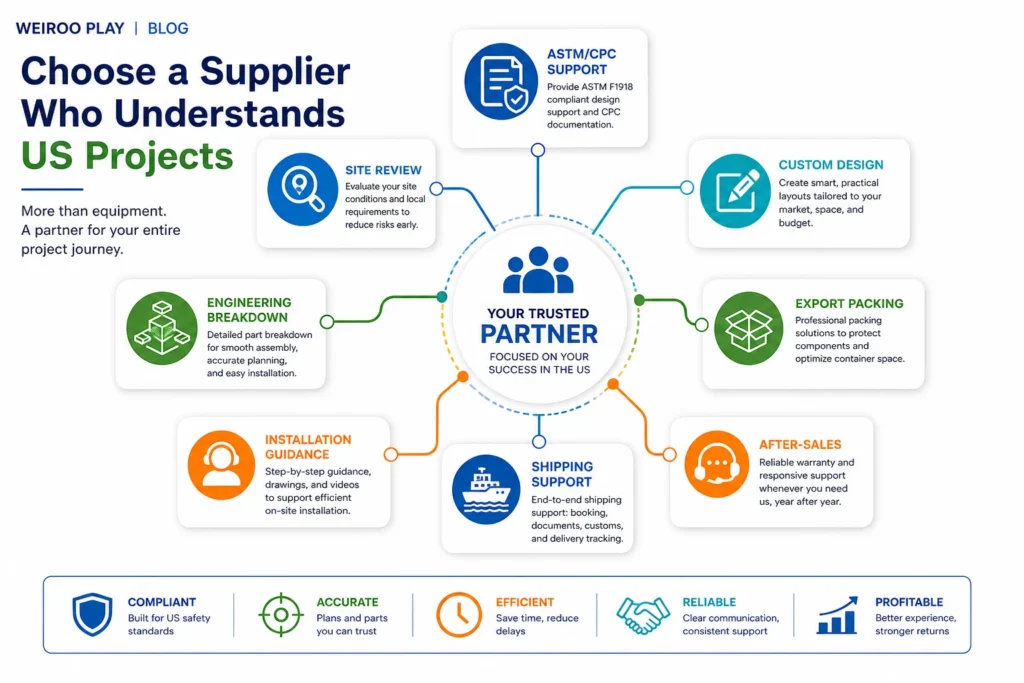
For a US indoor playground, choosing the lowest equipment quote is risky if the supplier cannot support the parts that happen after design approval.
You want a manufacturer who can discuss ASTM F1918, possible CPSIA/CPC documentation, customs classification, packing, engineering breakdown, installation guidance, and local site limitations.
You also want a supplier who can tell you when your original idea does not fit the building. That may not feel pleasant in the first meeting, but it is much better than discovering the issue during installation or inspection.
Weiroo should be positioned in this article as more than a product source: design planning, equipment customization, compliance document support, export shipping, installation guidance, cost control, and after-sales communication all matter.
That full-process ability is what US buyers need when they are opening for the first time.
FAQ
Q: What standards should an indoor playground follow in the USA?
A: For soft contained play equipment, ASTM F1918 is one of the key standards to discuss with your supplier. You should also confirm local fire rules, insurance requirements, landlord rules, state or city permits, and any documentation needed for customs or product compliance. Some projects may involve CPSIA/CPC documentation, so it is better to check with your customs broker, insurance provider, and local authority before production begins. The main point is to make compliance part of the design discussion, not a final document check.
Q: Is ASTM F1918 required for every indoor playground in the USA?
A: ASTM F1918 is highly relevant for soft contained play equipment, but actual requirements can vary depending on the state, city, venue type, insurance company, and equipment mix. The safe approach is to treat ASTM F1918 as an important design reference and confirm local requirements early. A supplier with US project experience should help you think about the standard during layout, not after the 3D design is finished. This is especially important for safety zones, use areas, access points, and protection details.
Q: What equipment is popular for indoor playgrounds in the USA?
A: Birthday party rooms, toddler soft play, interactive ball areas, light climbing routes, role-play zones, and comfortable parent lounges are all strong options in many US projects. If the venue has limited height, it may be better to focus on children under 9 instead of forcing large trampoline areas. A clear age position can help the project avoid direct competition with trampoline parks and improve repeat visits. Parent comfort also matters, so seating, visibility, noise control, and party flow should be planned early.
Q: What costs do US buyers usually underestimate?
A: US buyers often underestimate tariffs, ocean freight, and installation. For our category, HS/HTS code 95069990 is commonly used, but the final classification and tariff should be confirmed with a customs broker. For larger projects, installation can take longer than expected, and Weiroo often recommends sending installation staff or engineers while the client hires local workers. Flights, accommodation, transport, meals, and daily wages should be budgeted early. This is part of the real landed cost, not an optional extra.
Q: When should I contact a supplier for a US indoor playground project?
A: The best time is before signing the lease, because the supplier can help review ceiling height, columns, exits, circulation, fire access, and whether the site matches your intended customer group. If you wait until after the lease is signed, some decisions become harder and more expensive to change. Early supplier input can prevent the wrong equipment mix, poor layout flow, and installation problems later. It can also help you decide whether to target toddlers, children under 9, or a wider family entertainment market.
Sources
- ASTM F1918 – soft contained play equipment standard reference.
- CPSC Children’s Product Certificate – CPC documentation reference.
- USITC Harmonized Tariff Information – HTS tariff reference.
- CBP Basic Importing and Exporting – US importing process reference.