Trampoline assembly cost is not only the fee you pay an installer for a few days of work. For a commercial trampoline park, the real cost includes labor efficiency, project size, installation time, travel, accommodation, meals, tools, on-site coordination, and the risk of delaying your opening.
This is why the question is not simply, “Can I install it myself?” A better question is, “Does my project have the right installation experience on site to finish correctly, efficiently, and safely?”
For small and simple projects, local installation can work if the workers have experience with playground or trampoline park installation and the supplier provides clear installation documents. For larger projects, especially those over 500 sqm, we usually recommend sending Weiroo installers or engineers to guide the work on site.
The goal is not to make every customer choose the most expensive installation option. The goal is to choose the installation plan that protects the project schedule, budget, and final safety result.
Trampoline Assembly Cost Is Not Only the Installer Fee
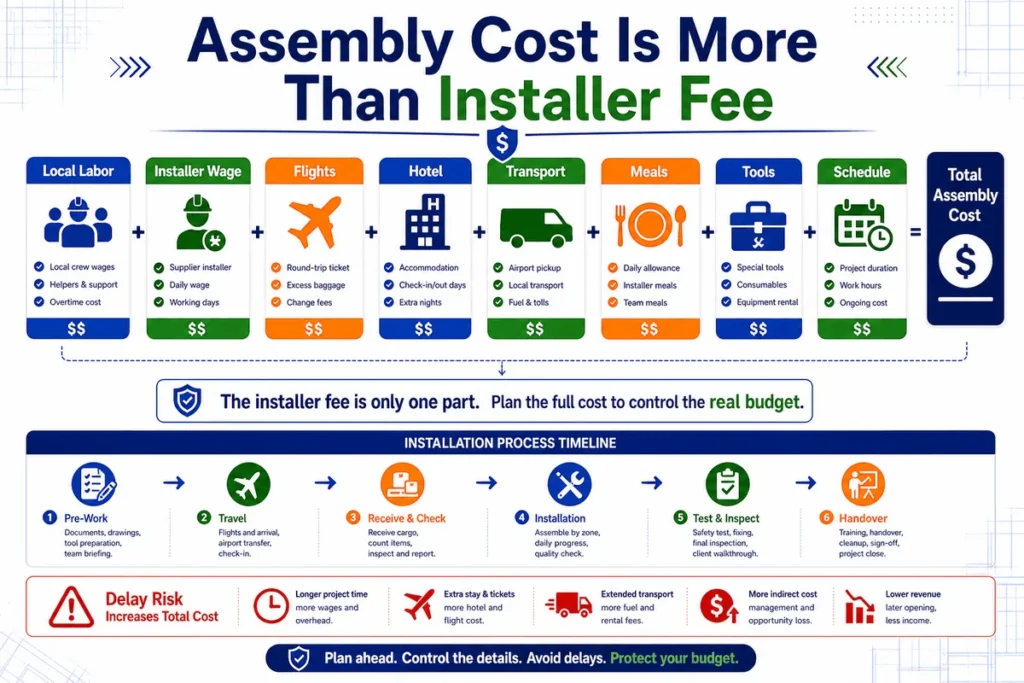
Many buyers calculate installation too narrowly. They ask how many workers are needed and how many days the work will take, then multiply by the local daily wage. That is part of the calculation, but not the whole calculation.
A commercial trampoline park has many linked parts: steel frames, jump mats, springs, pads, safety nets, platforms, foam pit or airbag areas, wall protection, entrance systems, labels, and sometimes ninja or challenge elements. If the installation sequence is wrong, the team may lose time correcting earlier work.
The real budget should include local workers, possible overseas installer wages, flights, accommodation, local transport, meals, tools, lifting equipment if needed, and the total installation period. A larger project can take one month or even longer, so the labor cost accumulates quickly.
What buyers often underestimate is not one single expense. It is the way daily costs keep adding up when the team is slow, confused, or waiting for technical answers.
That is why Weiroo discusses installation during the quotation stage. Before the equipment ships, the customer should already have a realistic idea of the installation method, estimated schedule, and likely cost range.
Can You Install a Trampoline Park Yourself?
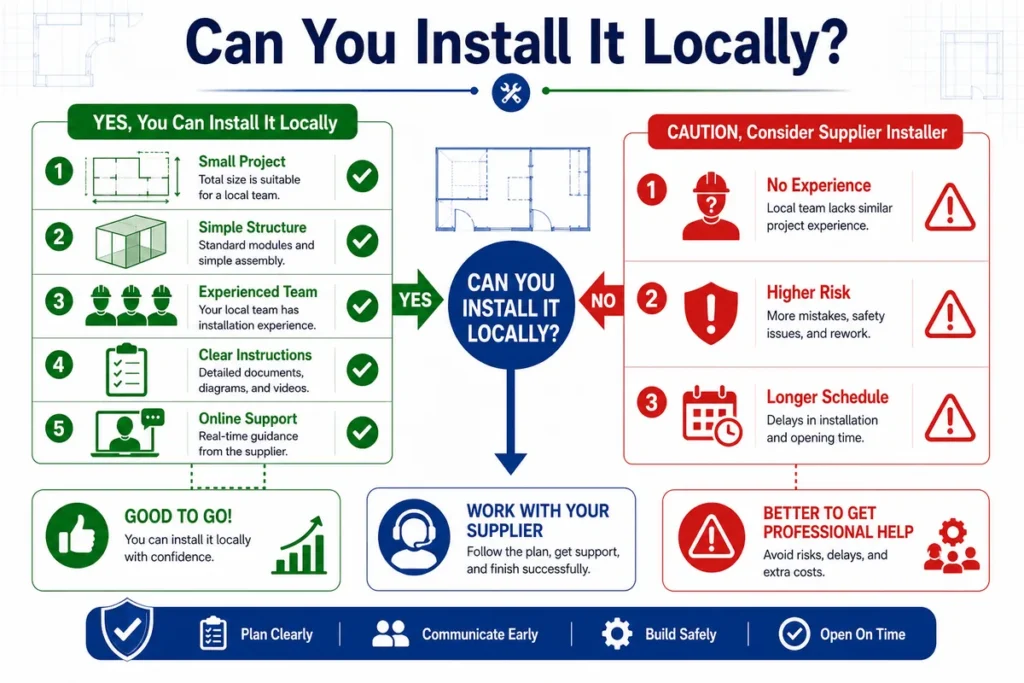
The honest answer is: sometimes, but not always.
If the project is small, the structure is simple, and the local team has experience installing playgrounds or trampoline parks, local installation with remote support can be practical. In many countries, playground installation has already become a real trade. A team with that background may understand site preparation, part sorting, structural sequence, fastening, padding, and safety checks better than a general construction crew.
In that case, Weiroo can provide detailed installation instructions and online support. Our engineering team prepares installation documents whether or not Weiroo is responsible for the on-site installation. The customer is not left with only a 3D rendering and a container of parts.
But if the local workers have no playground installation experience, the risk changes. They may be hardworking, but they may not understand the trampoline system. They may not know which parts should be sorted first, which sequence matters, or how small errors can affect later steps.
DIY installation can save money only when the team has the right experience. If inexperience turns a two-week job into a five-week job, the cheaper option may not be cheaper anymore.
When We Recommend a Professional Installation Team
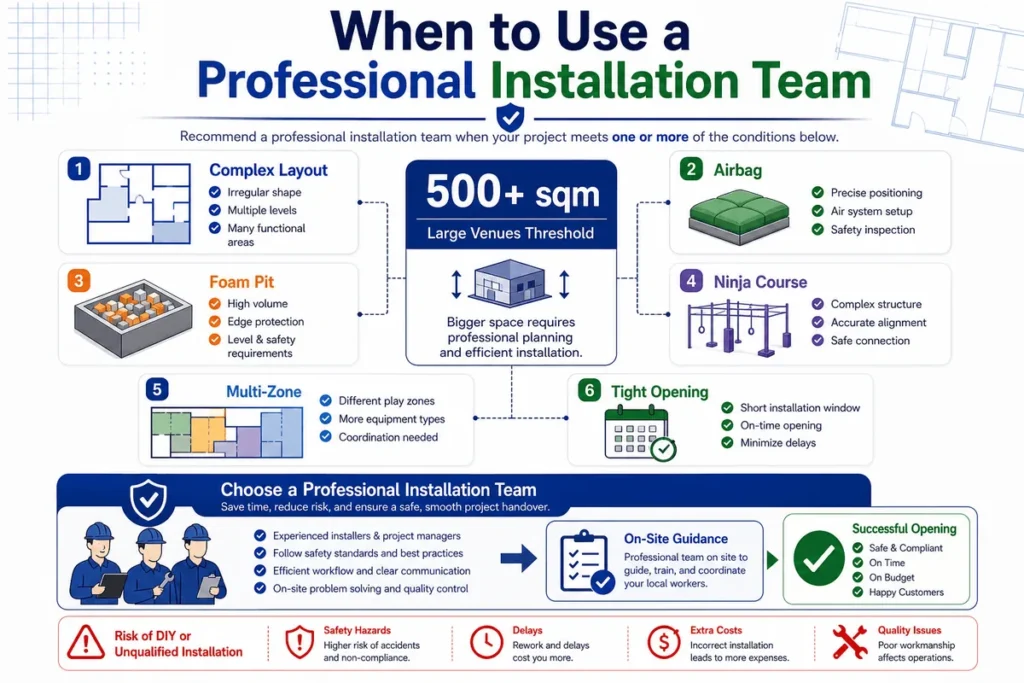
As a general rule, when a trampoline park is over 500 sqm, we recommend sending Weiroo’s installation team or at least one experienced installer to guide the local workers.
The reason is not only size. A larger project has more parts, more zones, more coordination, and more opportunities for mistakes. If the park includes an airbag, foam pit, ninja course, multi-level platforms, wall trampolines, angled trampolines, or several connected areas, the installation needs stronger technical control.
Correct installation matters because trampoline parks are safety-sensitive commercial venues. The installation should support the design, manufacturer instructions, and applicable standards. For example, ASTM F2970 covers trampoline courts in relation to design, manufacture, installation, operation, maintenance, inspection, and major modification. ISO 23659:2022 also addresses trampoline park safety requirements, including design, construction, inspection, and maintenance.
These references do not replace local authority or insurance requirements, but they show why installation should be treated as part of the safety system, not only as labor work.
If your opening date is tight, professional guidance becomes even more valuable. A slow or incorrect installation can delay staff training, inspection, soft opening, marketing, and revenue.
The Local Worker Option: When It Can Work
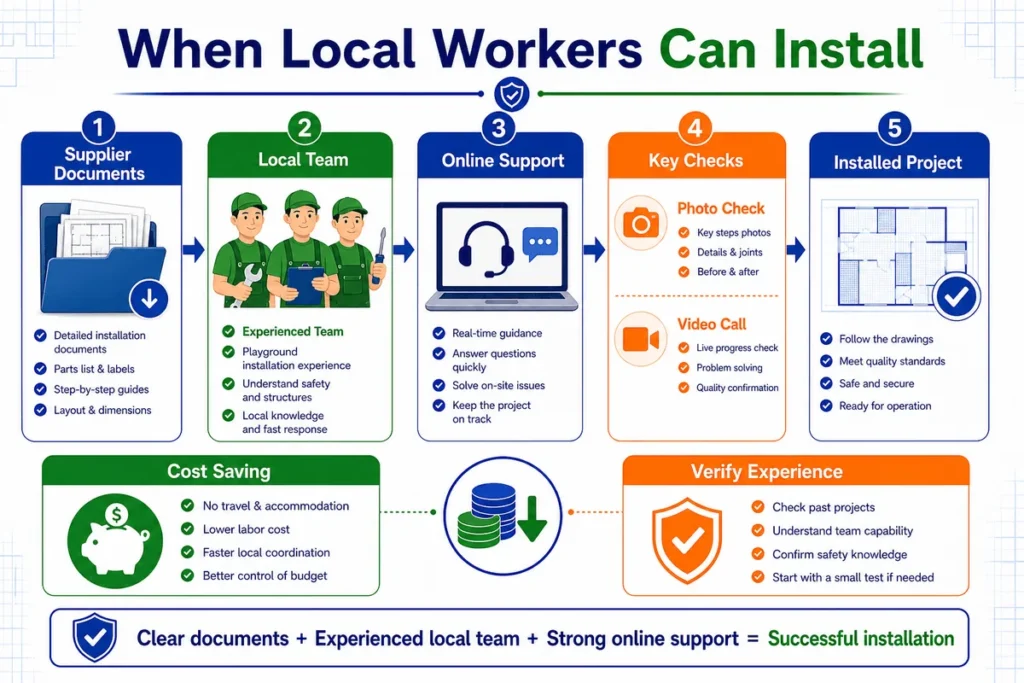
Local installation is not a bad option by default. In many projects, it is the most cost-effective method, especially when the customer can find a team that already installs playgrounds, indoor play equipment, trampoline parks, or similar commercial structures.
The best version of this model is simple: Weiroo provides the installation drawings, technical instructions, part information, and online support; the customer hires local workers who understand site work; and both sides communicate during key stages.
This approach can reduce travel costs because the customer does not need to pay for a full overseas installation team. It can also be faster if the local team is available immediately and understands the local site conditions.
But the local team must be honest about its experience. A general construction team is not always the same as a playground installation team. If they have never installed a trampoline park, they may need more guidance than expected.
If you are choosing this route, ask your local team what similar projects they have installed before. Photos, project names, or even a short conversation about the installation sequence can reveal a lot.
The Biggest Risk of Inexperienced Local Workers
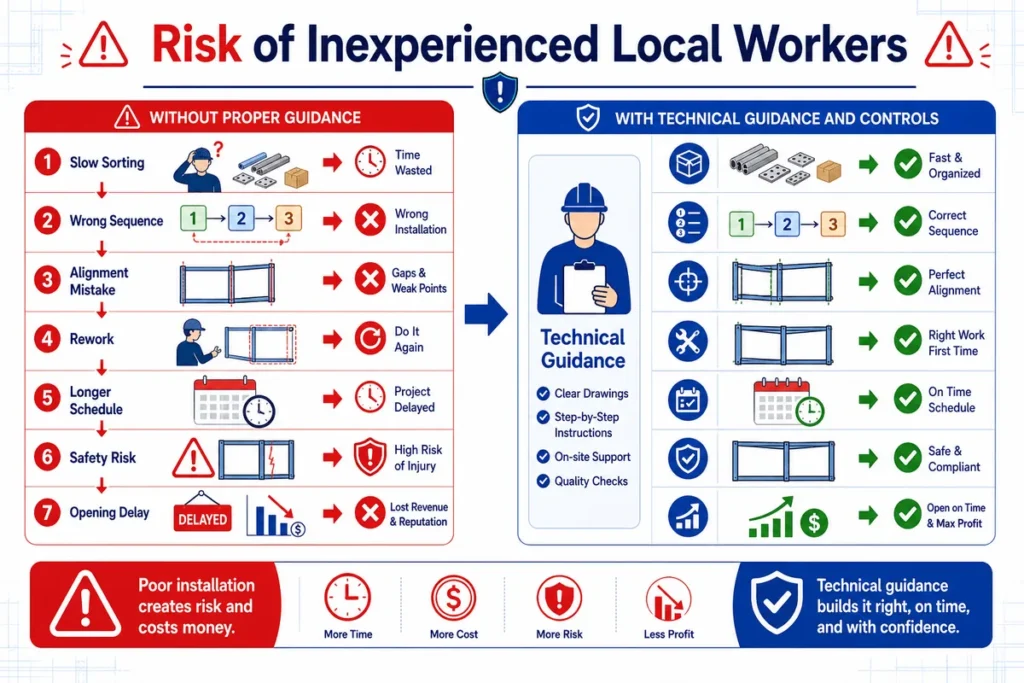
The biggest risk is not that local workers cannot work hard. The problem is that they may work in the wrong order or misunderstand the structure.
With inexperienced workers, common problems include slow part sorting, confusion with labels, wrong installation sequence, incorrect frame alignment, repeated adjustments, and uncertainty about pads, springs, nets, jump mats, or platform details. Each small issue can slow down the next stage.
When a trampoline park has many zones, these delays stack up. A few hours lost every day can become many extra days. Many extra days can become extra labor cost, delayed opening, and pressure from the landlord or investor.
More importantly, correct installation is needed to meet the intended safety result. A trampoline park is not a simple steel frame display. It is a commercial activity space where people jump, run, land, climb, and move quickly. The installation has to respect the system design.
That is why professional guidance is often less about “doing the heavy work” and more about making the right technical decisions on site.
What Weiroo Usually Recommends
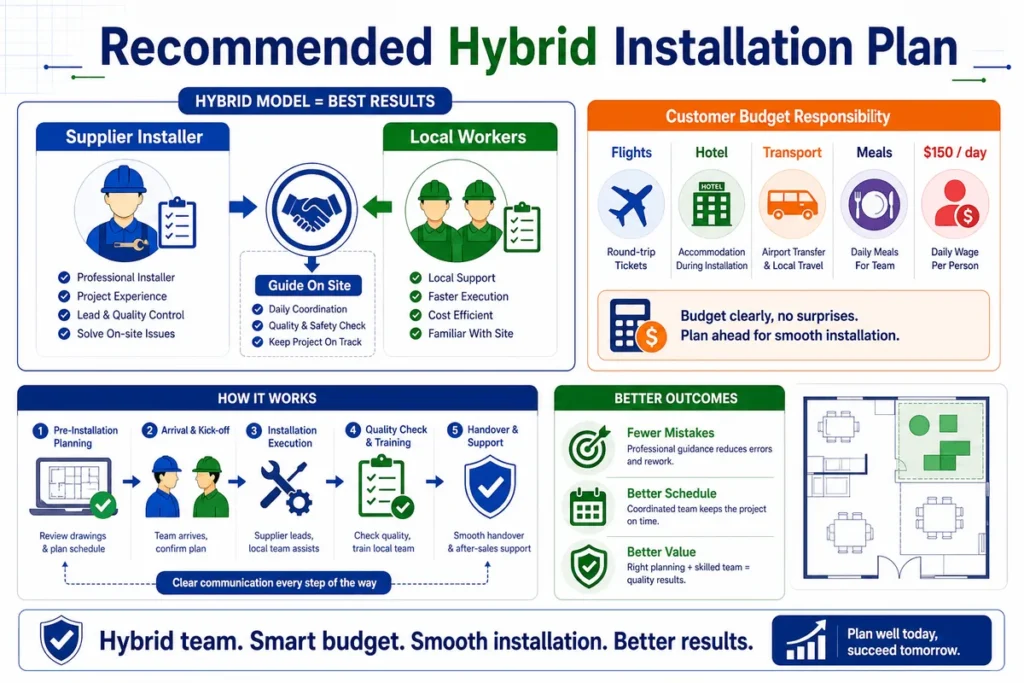
Weiroo’s usual recommendation depends on the site, project size, equipment mix, and local labor situation. For many larger trampoline park projects, the most practical plan is: one or more Weiroo installers or engineers go to the site, and the customer hires several local workers to assist.
This is often more cost-effective than sending a full overseas installation team, because local workers can handle much of the physical labor. At the same time, Weiroo’s installer can guide the sequence, check key points, answer technical questions, and reduce avoidable mistakes.
The customer should budget for the Weiroo installer’s round-trip flights, accommodation, local transportation, meals, and daily wage. Our installer wage reference is $150 per person per day. The final number of Weiroo installers depends on the project size and complexity.
This model gives the customer a balance: professional on-site direction without paying for every worker to travel internationally.
If the project is smaller or the local team is experienced, online support may be enough. If the project is over 500 sqm, complex, or the local team is inexperienced, we usually recommend on-site guidance.
Installation Costs Buyers Often Underestimate
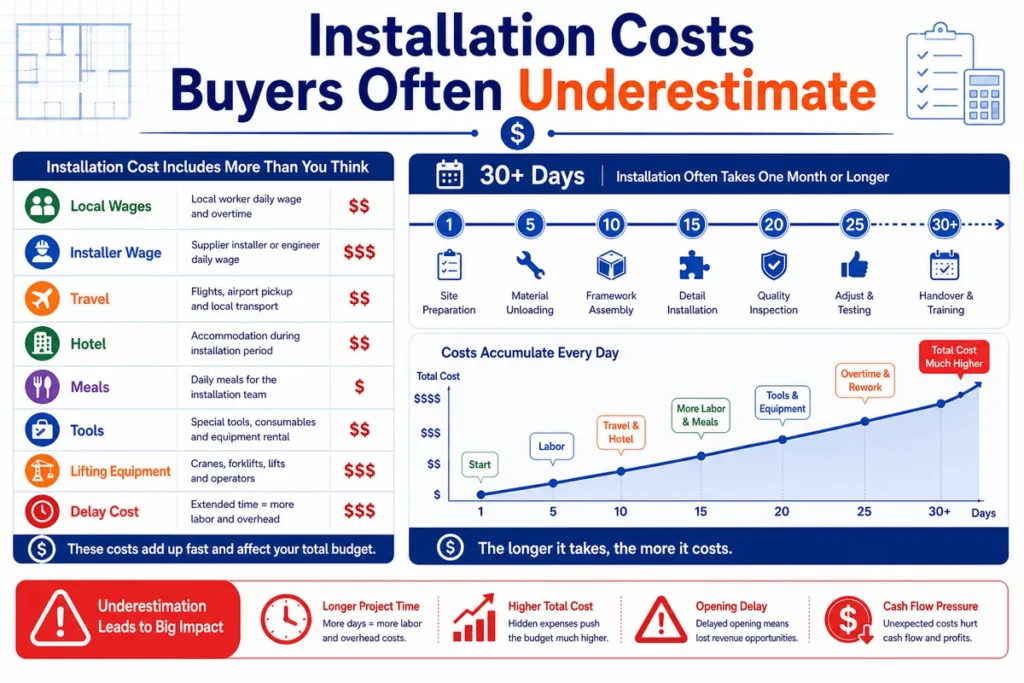
The cost buyers most often underestimate is total labor over time.
For a large trampoline park, installation may take a month or longer. During that period, you may be paying local workers every day. If Weiroo sends installers, you may also be paying flights, hotel, transport, meals, and daily wages. These costs are reasonable when planned early, but they can feel stressful if the buyer only thinks about them after the goods arrive.
The second underestimated cost is delay. If a project opens two weeks late, the cost is not only labor. The owner may lose early revenue, marketing momentum, birthday party bookings, staff readiness, and confidence from partners.
The third cost is rework. If a team installs a section incorrectly, it may need to be taken apart and rebuilt. That means more labor, more time, and more frustration.
Weiroo tries to reduce these risks by preparing the installation plan early. We help estimate the installation method, likely labor needs, and schedule before the customer commits to the final plan.
Case: A 990 sqm US Project That Needed On-Site Guidance
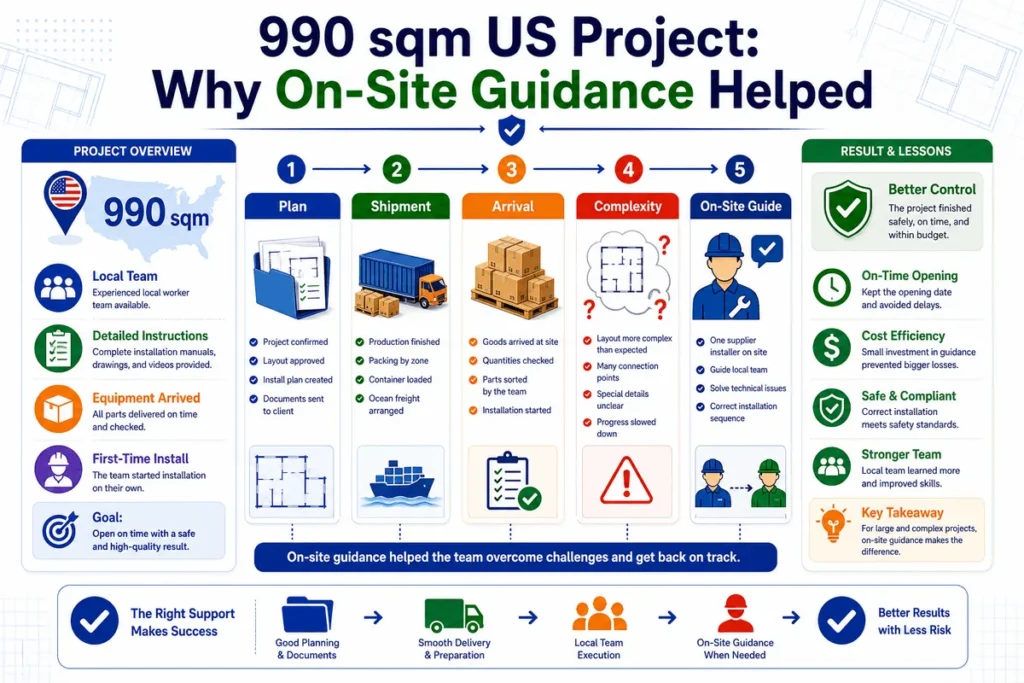
One US project shows the issue clearly. The site was about 990 sqm, and the client had a friend with a worker team. At first, the client did not ask Weiroo to send installers because he believed the local team could handle the work.
Before shipment, Weiroo prepared detailed installation instructions. The project was not sent without guidance. But after the equipment arrived, the local team saw the full project, the parts, and the installation scope. Because it was their first time installing this type of trampoline park, they decided they wanted Weiroo to send one installer to guide the work on site.
This is a common real-world situation. A local team may be capable, but when the project is large and unfamiliar, on-site technical direction gives everyone more confidence.
The lesson is not that every project needs a full overseas team. The lesson is that large projects need someone who understands the system and can make decisions when the site team is uncertain.
How to Decide: DIY, Local Team, or Weiroo Installer?
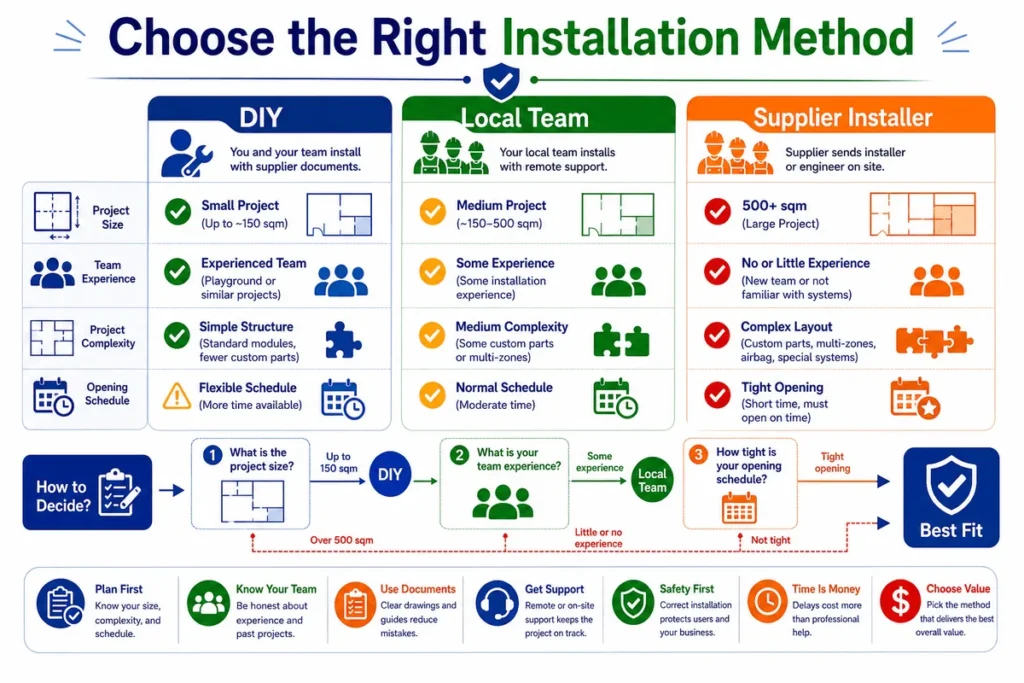
Use the installation method that matches the project risk.
If the project is small, the structure is simple, and the local team has real playground installation experience, local installation with online support can work. This can be a good solution for buyers with strong local labor and a flexible opening schedule.
If the project is medium-sized and the local team has some relevant experience, Weiroo can provide online support and help confirm key stages through photos or video. This still requires careful communication and part management.
If the project is over 500 sqm, includes complex trampoline attractions, or uses workers with no trampoline park installation experience, on-site guidance is the safer choice. The cost may be higher, but the project is more likely to stay organized and correctly installed.
If you are still comparing suppliers, ask your trampoline park manufacturer about installation before you sign the order. A responsible supplier should explain whether your project is suitable for local installation, remote support, or professional on-site guidance.
If you are also comparing equipment budgets, our trampoline park cost breakdown guide can help you understand how installation connects with the full investment plan. You can also review our article on how to open a trampoline park if you are still deciding between an independent project and a franchise-style model.
For buyers who are close to ordering trampoline park trampolines for sale, the next step is to send the floor plan, project size, attraction mix, and local labor situation. From there, Weiroo can recommend a realistic installation plan before the equipment is produced and shipped.
FAQ
How much does trampoline assembly cost?
Trampoline assembly cost depends on project size, attraction complexity, local labor rates, installation time, and whether you need supplier-side installers on site. The cost may include local workers, flights, hotel, transport, meals, tools, and daily wages for professional installers. For Weiroo installers, the wage reference is $150 per person per day, plus travel-related expenses. Larger projects can take a month or longer, so the total labor cost can become significant if it is not planned before shipping starts.
Can I install a trampoline park with local workers?
Yes, local workers can install a trampoline park if the project is not too complex and the team has relevant playground or trampoline park installation experience. Weiroo can provide detailed installation instructions and online support. The risk increases when the local team has no experience with this type of project. In that case, they may sort parts slowly, misunderstand the sequence, or extend the schedule. Local installation works best when the team already understands commercial play equipment and can communicate quickly.
When should I hire a professional trampoline park installation team?
We usually recommend professional on-site guidance when the trampoline park is over 500 sqm, includes complex areas, or the local workers do not have trampoline park installation experience. Airbag areas, foam pits, ninja courses, wall trampolines, and multi-zone layouts all increase the need for technical control. A professional installer can guide the sequence, check key points, and reduce mistakes. This is especially important when the opening date is tight, labor cost is high, or inspection timing matters locally.
What does Weiroo provide if I install locally?
Weiroo provides detailed installation instructions from the engineering team, even when the customer chooses local installation. Depending on the project, we can also provide online support through photos, video calls, and technical communication during key steps. If the project later needs more help, Weiroo can send one or more installers to the site to guide the local workers. The exact plan depends on the venue size, project complexity, local team’s experience, opening schedule, available labor, site conditions, and technical difficulty.
What installation cost do buyers usually underestimate?
Buyers usually underestimate total labor over time. A large trampoline park may take one month or longer to install, so daily local wages and supplier-side installer costs keep accumulating. Travel, accommodation, meals, transportation, tools, and possible lifting equipment can also add to the budget. The other hidden cost is delay. If installation takes longer than expected, the opening date, staff training, marketing plan, early bookings, early revenue, landlord coordination, inspection schedule, and cash flow can all be affected badly.
Sources
- ASTM F2970 – reference for trampoline court design, manufacture, installation, operation, maintenance, inspection, and major modification.
- ISO 23659:2022 – reference for trampoline park safety requirements covering design, construction, inspection, and maintenance.
- IATP Standards & Research – industry reference for trampoline and indoor adventure park safety standards.