Starting an commercial indoor playground is a dream for many, but turning that dream into a profitable reality requires one thing above all else: a solid indoor playground business plan.
I have reviewed hundreds of plans from entrepreneurs visiting our factory. The difference between those who get funded by banks and those who get rejected comes down to Data Precision.
Banks do not fund “fun ideas”; they fund ROI (Return on Investment). They want to see that you understand Throughput, Revenue per Square Meter, and EBITDA Margins.
In this guide, we strip away the fluff. We will walk you through the 7 essential sections of a professional business plan, backed by the hard numbers you need to convince investors.
What Must Your Business Plan Include?
To secure funding in 2026, your plan must cover these 7 pillars:
- Executive Summary: The financial snapshot.
- Market Analysis: TAM (Total Addressable Market).
- Operational Plan: Capacity calculation & Installation.
- Design & Visuals: Space Efficiency Rates.
- Financial Projections: The “Golden Ratio” of expenses.
- Marketing Strategy: Digital acquisition & Pre-sales.
- Risk Management: Insurance & Compliance.
Section 1: Executive Summary
This is the first page investors read. It must be concise.
- Concept: A 600 sqm Hybrid Adventure Park combining soft play (0-8 yrs) and trampolines (8-16 yrs).
- The Ask: “Seeking $150,000 financing to complement $100,000 owner equity.”
- Key Metric: “Projected Annual Revenue: $650,000. Break-even: Month 14. Net Margin: 28%.”
Section 2: Market Analysis (Data, Not Guesses)
Prove the demand with specific demographic data.
Catchment Area (The 20-Minute Rule)
Families rarely drive more than 20 minutes for a “regular” play session.
- Requirement: You need a population of 50,000+ people within this 20-minute drive circle.
Target Demographics
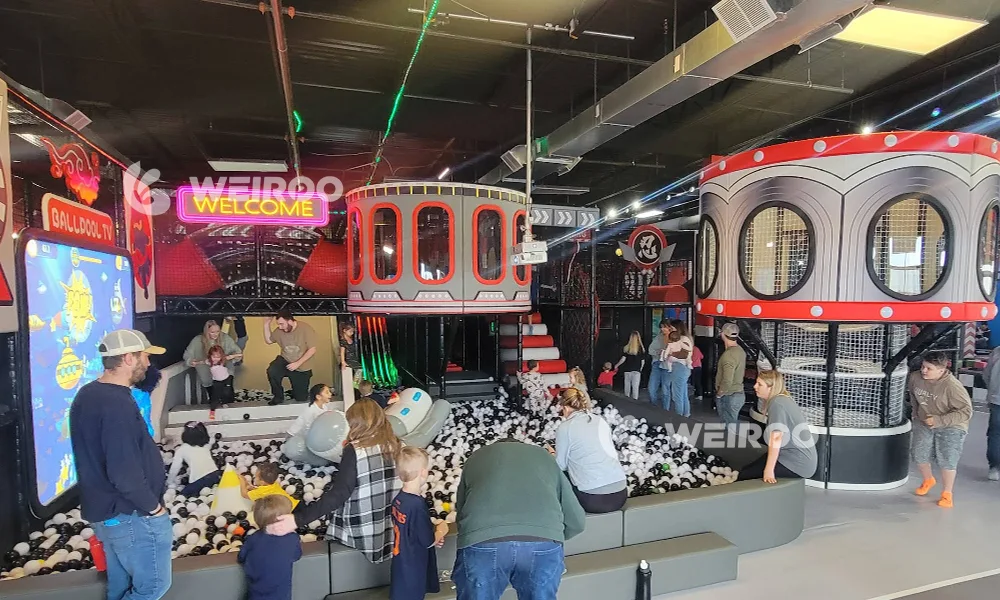
- Soft Play: Families with kids 0-8 years. (Focus: Repeat visits, memberships).
- Trampoline: Teens 12-25 years. (Focus: High ticket price, events).
- Note: If you plan to start a indoor trampoline parks business, verify the local high school population.
Section 3: Operational Plan (The Math of Capacity)
This is the most critical section for calculating potential revenue. Do not guess. Use these formulas.
1. Maximum Occupancy (Static Capacity)
How many people can fit in your park safely at one time?
- Industry Standard: 1 person per 4 square meters (approx. 40 sq. ft) of active floor area.
- Formula: Total Park Size (sqm) ÷ 4 = Max Capacity
- Example: 600 sqm Park ÷ 4 = 150 Simultaneous Players.
2. Daily Throughput (Dynamic Capacity)
How many tickets can you sell in a day?
- Weekend Multiplier: On Saturdays, average stay is 2 hours. You can turn over your capacity 4-5 times.
- Calculation: 150 Capacity x 5 Turns = 750 Tickets per Saturday.
- Weekday Multiplier: Much lower. Typically 10-15% of weekend volume.
- Calculation: 750 x 15% = ~112 Tickets per Tuesday.
3. Installation Strategy (Risk Control)
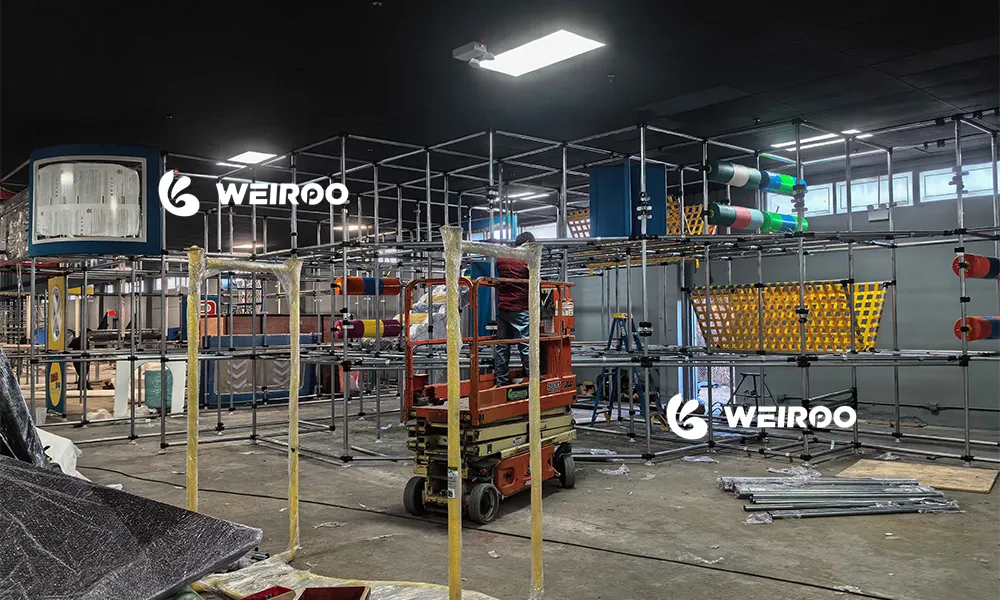
Investors fear construction delays.
- The Plan: State clearly: “We will utilize Weiroo Play’s Global Installation Service. Certified engineers will travel to the site to supervise assembly, ensuring the project finishes within the 20-day timeline and meets ASTM safety standards.”
Section 4: The Equipment & Design (Space Efficiency)
Visuals sell, but Efficiency makes money.
- The 70/30 Rule: Your design should aim for 70% Active Play Area and 30% Ancillary Area (Café, Reception, Party Rooms). If your Café takes up 50% of the space, your Revenue per Square Meter drops.
- The Solution: Include a professional 3D Render showing this optimization.
- How to get it: As a premier indoor play area manufacturers, Weiroo Play offers free 3D design services. Send us your CAD file, and we will build the visual model for your bank presentation.
Section 5: Financial Plan (The “Golden Ratio”)
This is where you prove the business is profitable. Use these Industry Benchmarks to build your P&L (Profit & Loss) forecast.
1. Revenue Mix (Where money comes from)
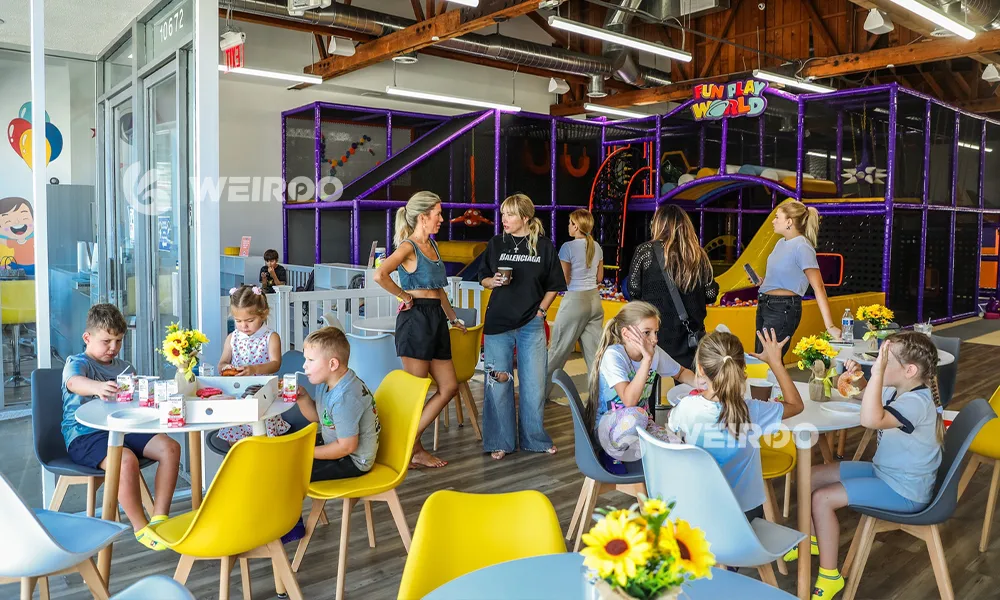
A healthy park should aim for this split:
- 45% – Open Jump/Play Tickets: (High margin, volume driven).
- 35% – Birthday Parties: (Highest margin product. Pre-booked cash flow).
- 15% – Food & Beverage (F&B): (Aim for 65% gross margin on coffee/pizza).
- 5% – Merchandise: (Socks, toys).
2. Expense Ratios (Where money goes)
To maintain a healthy 25-35% EBITDA Margin, keep your costs within these limits:
- Rent: Should not exceed 15-18% of projected revenue. (If rent is higher, you need higher ticket prices).
- Labor: 20-25% of revenue. (Don’t overstaff on weekdays).
- COGS (Cost of Goods Sold): 8-10% (Food cost + Socks cost).
- Marketing: 3-5% (Reinvest into Google/Social Ads).
- Maintenance: 1-2% (Reserve for spring replacements/repairs).
3. Startup Cost Estimate (500 sqm / 5,400 sq.ft)
Based on Factory-Direct Pricing ($100 – $120 per sqm)
| Cost Category | Estimated Range (USD) | Notes & Benchmarks |
| Playground Equipment | $50,000 – $60,000 | Weiroo Direct. Includes Soft Play, Trampolines & Ninja Course. |
| Fit-out & Renovation | $40,000 – $60,000 | HVAC, Lighting, Flooring, and Party Rooms decoration. |
| Shipping & Installation | $15,000 – $20,000 | Global shipping + Professional on-site assembly team. |
| Operational Launch | $30,000 – $40,000 | Rent Deposit (3 months), POS System, and Pre-opening Marketing. |
| TOTAL INVESTMENT | $135,000 – $180,000 | High Affordability |
| VS. Franchise Model | $400,000+ | You save ~60% by avoiding franchise fees & markups. |
Section 6: Marketing Strategy (Weiroo Exclusive)
Building it is not enough. You need a customer acquisition system.
1. Digital Dominance: Professional Website
90% of traffic comes from Google Maps. You need a high-speed, SEO-optimized website.
- The Cost Problem: Hiring a local web agency in the US or Europe typically costs $3,000 – $5,000.
- The Weiroo Solution: We have an in-house Web Engineering Team in China. Due to currency exchange rates and operational efficiency, we can build a world-class, SEO-structured website for you at a fraction of the local cost. You get the same high quality, but you save thousands of dollars to reinvest in your park.
2. The “Pre-Sell” Campaign
Generate cash before you open doors.
- Strategy: Sell 100 “Founding Member” passes at 50% off during construction.
- Goal: Raise $10,000 – $15,000 upfront to cover your Grand Opening marketing costs.
Section 7: Risk Management (The “Sleep Well” Section)
Show investors you take safety seriously.
1. Insurance Types
Budget for these policies:
- General Liability: Covers customer injuries.
- Workers’ Comp: Covers staff injuries.
- Weiroo Advantage: Our equipment comes with TUV/ASTM certificates. Submitting these to your insurance broker often results in lower premiums compared to uncertified equipment.
2. Safety Standards
Explicitly state adherence to international codes:
- USA: ASTM F2970 / F1918.
- Europe: EN 1176.
3. Maintenance Protocols (Daily Checklist Examples)
Include a sample of your daily safety routine in the appendix of your plan. This proves diligence.
- [ ] Netting: Check for any tears larger than 3mm or loose zip ties.
- [ ] Padding: Ensure all vinyl covers are secure; no exposed metal or foam.
- [ ] Obstacles: Check soft play obstacles for stability; ensure no loose screws.
- [ ] Cleanliness: Sanitize ball pit surface and remove any foreign objects (coins, hair clips).
Conclusion: Stop Guessing, Start Calculating
An indoor playground business plan is a mathematical proof that your location + our equipment = profit.
By partnering with Weiroo Play, you get the Factory-Direct Pricing to lower your startup costs and the Design/Web Support to boost your revenue.
Ready to calculate your ROI? Contact us today for a Free Custom 3D Design and a Detailed Price Quote to complete your business plan.
FAQ (Frequently Asked Questions)
Q1: What is the average break-even time for an indoor playground?
With factory-direct equipment (lowering CapEx), a well-run 500 sqm park typically breaks even in 12 to 18 months. Franchise models often take 24-36 months due to higher fees.
Q2: How much revenue can a 500 sqm park generate?
While it varies by location, a standard benchmark is $800 – $1,200 revenue per square meter annually. For a 500 sqm park, this means $400k – $600k annual revenue potential.
Q3: Why is “Capacity” more important than “Traffic”?
Capacity dictates your Revenue Ceiling (Earnings cap). On busy Saturdays, if your capacity is too low, you are turning away money. Weiroo optimizes layouts (e.g., adding mezzanines) to maximize capacity within the same footprint.
Q4: Do I really need a website engineer?
Yes. Local SEO is competitive. While we cannot guarantee a #1 ranking overnight, our engineering team builds your site with the correct technical structure (Schema markup, speed optimization) that Google loves, giving you the best possible foundation at a much lower cost than Western agencies.