Introduction
Search online for “trampoline park startup costs,” and you’ll find vague estimates ranging from $100k to $500k. As a manufacturer who has successfully built parks across North America, Europe, and Asia, I know these general numbers are useless for serious investors.
You don’t need a range; you need real unit prices.
In 2026, the factory-direct reality is clearer:
- Standard Configuration: Around $100 per sqm (approx. $9.30 per sq. ft.).
- Focuses on classic, high-traffic attractions like Free Jump & Foam Pits.
- Premium Configuration:$120+ per sqm (approx. $11.15+ per sq. ft.).
- Includes complex structures like Ninja Courses, Tag Arenas, or Interactive Games.

Here is the critical truth: A $100/sqm park is not “worse” than a $120/sqm park—it simply offers a different mix of attractions. Whether you are targeting a competitive market in the USA or an emerging market in Eastern Europe, success isn’t about how much you spend per meter.
It is about Strategic Layout Efficiency.
Below, we dismantle the entire startup budget—covering everything from the raw steel framework and franchise fees to daily labor rates. Our goal is to demonstrate how to engineer the ideal attraction mix tailored to your specific market demands.
Factory Direct vs. Resellers: Where is the Money Going?
To understand the price tags, you first need to understand the supply chain.
A significant number of “local” brands in the US and Europe act as intermediaries, simply relabeling products manufactured in Asian factories like ours.
Let’s look at the financial reality when comparing the exact same ASTM-compliant trampoline park equipment:
| Cost Item | Local Reseller / Brand | Factory Direct (Weiroo Play) |
| Equipment Cost | $180 – $250 / sqm ($16 – $23 / sq. ft.) | $100 – $140 / sqm ($9 – $13 / sq. ft.) |
| Design Fees | Often charged extra ($2k+) | Free (Included) |
| Customization | Limited to catalog | Fully Custom (Color/Logo) |
By going direct, you are essentially cutting out the middleman markup, allowing you to invest that budget into better attractions or marketing.
Franchise vs. Independent Brand: A $50k Decision
Before finalizing your equipment budget, one of the first strategic decisions you face is: Should I buy a franchise (like Sky Zone/Urban Air) or build my own brand?
Many investors assume a franchise is safer, but the costs are significantly higher.
| Feature | Franchise Model | Independent Owner (With Weiroo) |
| Initial Fee | $30,000 – $60,000 (Just for the name) | $0 (Invest this in equipment instead) |
| Royalties | 6% – 8% of Gross Revenue (Monthly) | 0% (You keep 100% of profit) |
| Equipment | Must buy from their vendor (High markup) | Buy Direct (Factory Price) |
| Design Freedom | Restricted to brand standards | 100% Custom |
Our Advice: Unless you have zero business experience and absolutely need their handbook, building your own brand saves you nearly $100,000 in the first year alone. We help you look just as professional as a franchise, without the heavy fees.
$100 vs. $120 per Sqm: Understanding the Difference
When clients ask us about the price difference, we explain it simply: It’s about the Complexity of Play, not the Quality of Materials.
We utilize the identical premium hot-dip galvanized structural tubing and certified impact-absorbing padding across every single project, regardless of the price tier. The cost difference comes from the equipment selection:
1. The Standard Strategy ($100/sqm | ~$9.30/sq. ft.)
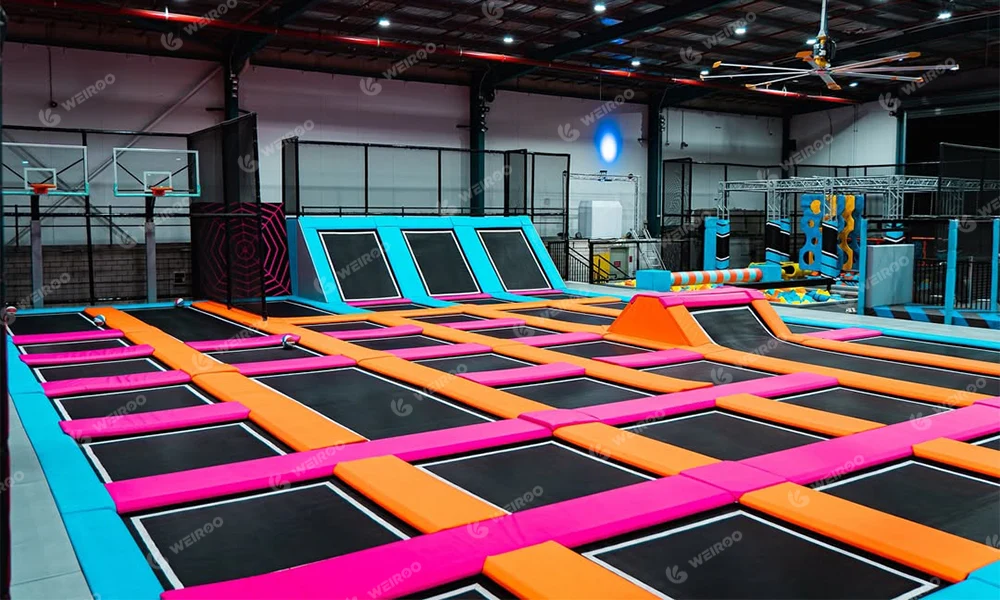
- Ideal For: High-volume Family Entertainment Centers (FECs) that require maximum passenger throughput and classic entertainment value.
- Core Components: Main Court (Free Jump), Dodgeball Arenas, Basketball Slam Dunk zones, and Foam Pits.
- The Strategic Advantage: These attractions are cost-efficient to produce yet remain timelessly popular, ensuring a higher volume of ticket sales per hour.
2. The Premium Strategy ($120+/sqm | ~$11.15+/sq. ft.)
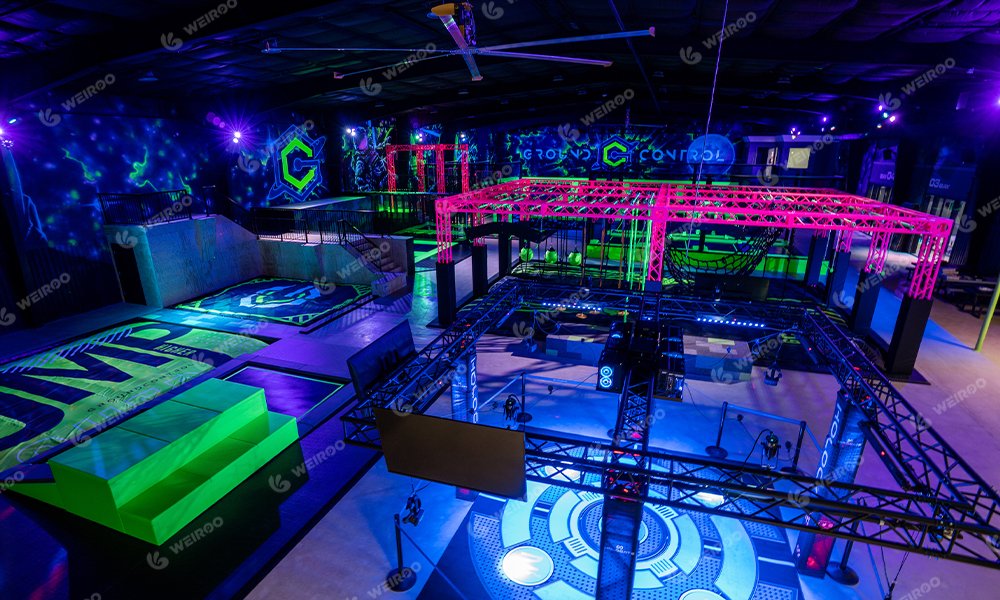
- Ideal For: Highly competitive markets (like major cities in the US or UK) where you need “Wow Factors” to stand out.
- Core Components: Multi-level Ninja Warrior courses, Gamified Tag Arenas, High-tech Interactive Projection games, or Indoor Coasters.
- The Strategic Advantage: These attractions create a unique selling point that competitors cannot easily copy.
Pre-Opening “Soft Costs”: What Else Do You Need?
Equipment is the biggest expense, but it’s not the only one. To open legally and safely, you must budget for “Soft Costs” that many new owners forget.
- Design & Engineering:
- Market Rate: Specialized architects charge $5,000 – $15,000 for detailed 3D layouts and structural drawings.
- Weiroo Play Advantage: We provide Free Conceptual Design and 3D rendering included in your equipment order.
- Insurance (Liability):
- In the US and Europe, General Liability Insurance is mandatory. Premiums depend heavily on your safety certifications.
- Tip: Using our ASTM/EN certified equipment can often lower your insurance premiums by 15-20% because insurers view them as “lower risk.”
- Permits & Inspections:
- Budget $2,000 – $5,000 for local fire department inspections, health & safety permits, and business licenses before you cut the ribbon.
Installation: The Hybrid Model (Recommended)
Installing a 500 sqm (approx. 5,380 sq. ft.) park is a complex engineering task. While we provide detailed 3D installation manuals for every project, we strongly recommend our “Hybrid Installation Service” to ensure safety and efficiency.
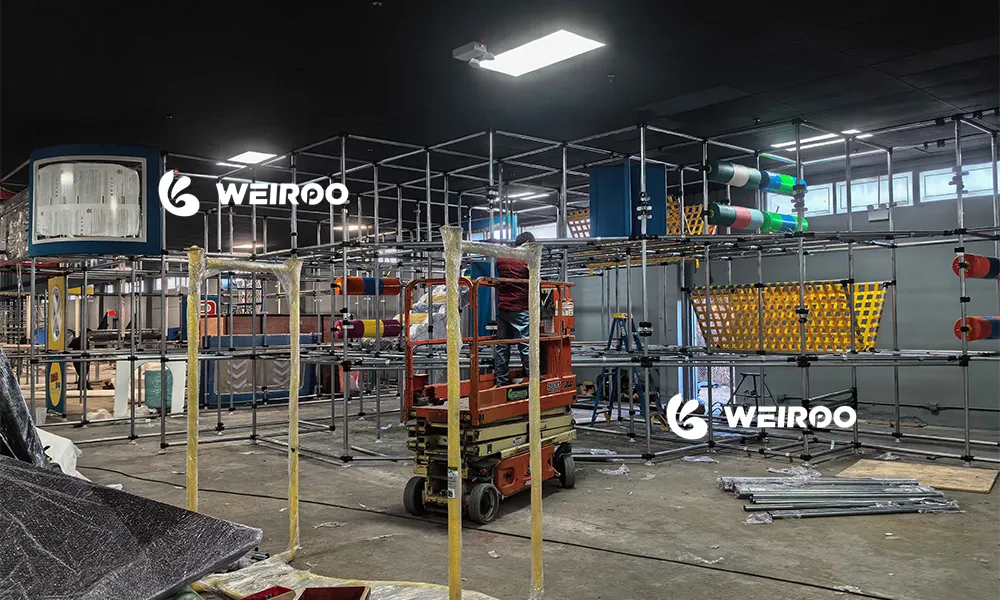
- The Workflow: We send 2 Senior Engineers from our factory to lead the project, while you hire 2 local workers to assist with heavy lifting.
- The Timeline: For a 500 sqm (5,380 sq. ft.) park, this process typically takes about 25 days.
- Cost Estimate: Our engineers typically cost $150 USD per person/day (plus round-trip tickets and accommodation).
Why pay for our engineers?
- Avoid Costly Mistakes: A local team unfamiliar with our specific structural joints might install parts upside down or loosely. Fixing these errors later can double your labor costs and delay opening.
- Safety Certification: Our engineers ensure every screw and spring meets the standard required for final safety inspections.
- Efficiency: They act as “site managers” to keep your local workers moving fast and on schedule.
Shipping & Logistics: Real Volume Estimates
Don’t underestimate the volume of trampoline parks. Because of the foam cubes, soft padding, and steel structures, a park is “bulky” cargo.
- Container Estimate: For a standard 500 sqm (5,380 sq. ft.) park, you will typically need 3 x 40HQ Containers (or sometimes 2 x 40HQ + 1 x 20GP), depending on the specific equipment mix.
- Cost Tip: We optimize the loading plan to fit as much as possible, but always budget for this volume.
- Incoterms: We recommend comparing CIF (to your port) vs. FOB (you handle shipping). We can assist with both to find the best rate for the current month.
Operational Expenses (OpEx): Keeping the Lights On
A profitable park isn’t just cheap to build; it must be sustainable to run. For a standard 500 sqm park, here are the monthly benchmarks you should aim for in 2026:
- Rent:To ensure healthy profit margins, your target is to secure a venue where lease payments consume no more than 15% to 20% of your total forecasted sales. Warehouse spaces in industrial zones are often 50% cheaper than shopping mall locations.
- Staffing:
- Safety Monitors: Aim for a ratio of 1 staff member per 15-20 jumpers.
- Front Desk: 1-2 staff for check-in and socks sales.
- Cost: Labor usually accounts for 25-30% of total revenue.
- Marketing:
- Budget 3-5% of revenue for Google Ads and Social Media.
- Pro Tip: Birthday parties are your highest margin product. Focus your ad spend on “Trampoline Birthday Party” keywords.
Revenue Potential: It’s Not Just About Tickets
While startup costs are fixed, your revenue potential depends heavily on your local economy and business model. To see the full picture, you need to estimate income from three main sources:
- Ticket Sales (The Baseline):
- Prices must be set according to local market tolerance. For example, parks in North America may charge $15-$25/hr, while markets in Southeast Asia or Eastern Europe might range from $8-$15/hr.
- Goal: A healthy park aims for 20%-30% occupancy on weekdays and 80%+ on weekends.
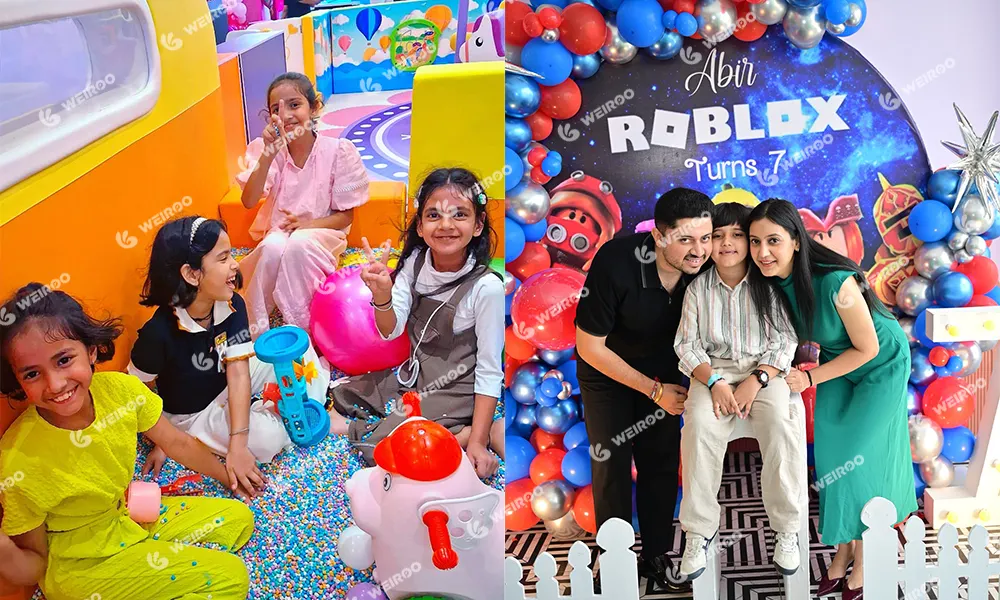
- Birthday Parties (The Gold Mine):
- This is your highest margin product. Parents are often willing to pay a premium package price because it includes food, hosting, and a private room.
- Factory Tip: Design your park with at least 2-3 “Party Rooms” to capture this revenue.
- Ancillary Income (Socks & F&B):
- Grip Socks: You buy them for ~$0.50 and sell them for $3.00. That is a 500% markup.
- Food & Beverage: Snacks and drinks typically contribute 15-20% of total park revenue.
The ROI Equation: How “Factory Direct” Accelerates Payback
While ticket prices vary by country (e.g., $15-$25/hr in the US vs. €8-€15/hr in Europe), the math of ROI (Return on Investment) remains the same:
Profit = Revenue – (Operating Costs + Initial Investment)
This is where your choice of trampoline park supplier changes your destiny.
- Scenario A (Buying from a Reseller): If you pay $200/sqm for equipment, your initial debt is high. You might need 18-24 months of steady operation just to pay back the equipment loan.
- Scenario B (Buying Factory Direct from Weiroo): If you pay $100-$120/sqm for the same quality equipment, your initial investment drops by ~40%.
The Result: Even with the same ticket prices and visitor numbers, your Break-Even Point (BEP) could drop to 10-14 months.
Every dollar you save on the initial “Capital Expenditure” (CAPEX) by going direct is a dollar of pure profit you will see months sooner.
Stop guessing and get an accurate budget
The biggest mistake we see new investors make is asking, “What is the cheapest park you can build?”
Rather, the critical question is: “How do we engineer a layout that compels visitors to extend their session beyond the first hour?”
At Weiroo Play, we don’t just sell steel and mats; we provide Market-Adaptive Design. Send us your floor plan (DWG/CAD) today, and we will provide a Free 3D Design and a precise cost breakdown tailored to your location.
[> Request Your Free Design & Quote <]
Frequently Asked Questions (FAQ)
Q1: How much does it cost to start a trampoline park in 2026?
The equipment cost typically ranges from $100 to $140 per sqm ($9-$13 per sq. ft.) if buying factory direct from China. However, total startup costs (including rent, renovation, and permits) for a 500 sqm venue usually range between $80,000 and $150,000 depending on your location.
Q2: How much space do I need for a trampoline park?
For a profitable commercial park, we recommend a minimum of 500 sqm (approx. 5,400 sq. ft.). This size allows enough capacity for birthday parties and diverse attractions. Ceiling height should be at least 5.5 meters (18 ft) for safety.
Q3: Is a trampoline park a profitable business?
Yes. With the right location and factory-direct equipment savings, many owners see a full Return on Investment (ROI) in 10 to 14 months. Birthday parties and grip socks sales significantly boost profit margins beyond just ticket sales.
Q4: Do I need a franchise to open a trampoline park?
No. Buying a franchise can cost $30k-$50k upfront plus 6-8% monthly royalties. By partnering with a manufacturer like Weiroo Play, you get free design services and professional equipment without paying any franchise fees or monthly cuts.