You have found the perfect building. You have a vision. But before you sign a 5-year commercial lease, one terrifying question keeps you awake at night:
“How long will it take to get my money back?”
Starting an indoor playground business requires a serious capital investment. You are paying for design, manufacturing, ocean freight, installation, and local permits. Unlike typical playground equipment suppliers who just want to sell you steel pipes and disappear, I want to see your business survive and thrive. A profitable client opens a second location; a bankrupt client does not.
To calculate your Return on Investment (ROI) and your Break-Even point, you need to stop looking at catalog prices and start doing the real math.
Here is the exact financial blueprint we use to analyze indoor playground equipment for business profitability.
1. The “Capacity Math”: How Much Money Can Your Box Hold?
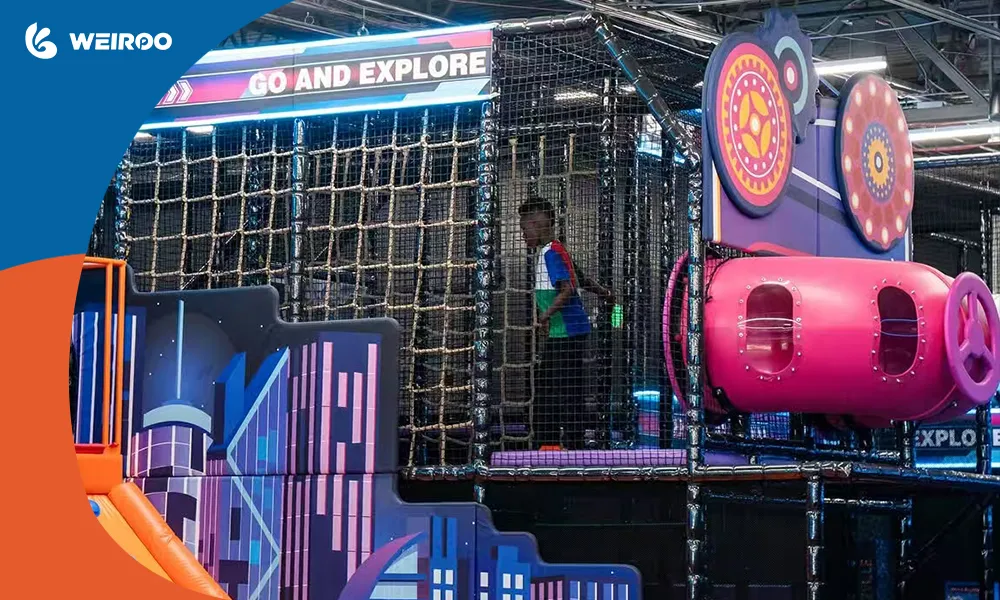
Before you project revenue, you must understand your absolute maximum capacity. You cannot sell 500 tickets if your venue only safely holds 150 kids.
The Golden Formula: 3 Square Meters Per Child To calculate your maximum safe capacity, take your total active play area (excluding the cafe, seating, and restrooms) and divide it by 3.
- Example: If you have an 800 sqm building, you might have 500 sqm of actual play structure.
- 500 sqm / 3 = 166 kids at maximum capacity.
Ticket Pricing Reality: In mature markets (like the USA, UK, or Australia), premium indoor playgrounds and trampoline parks typically charge $25 to $35 per hour. If your park is at full capacity (166 kids) on a rainy Saturday afternoon charging $30/hour, your gross ticket revenue is **$4,980 per hour**.
2. The “30% Rent Rule”: The Ultimate Death Trap
The number one reason indoor playgrounds go bankrupt is not bad equipment; it is toxic leases.
The Rule: Your monthly rent should never exceed 30% of your total projected monthly gross revenue. If your rent is 40% or 50% of your income, you are essentially working for your landlord. You will never break even.
The Exception to the Rule: Does this mean you should rent a cheap, dirty warehouse in the middle of nowhere? No. High rent means a prime geographic location (high foot traffic, premium demographics). However, if you accept high rent, you must justify it by installing highly advanced, visually stunning equipment. You cannot put basic, cheap soft play in a premium mall and expect to charge $35 a ticket. High rent demands a high-end attraction.
3. The Revenue Triangle: Tickets, Food, and Parties
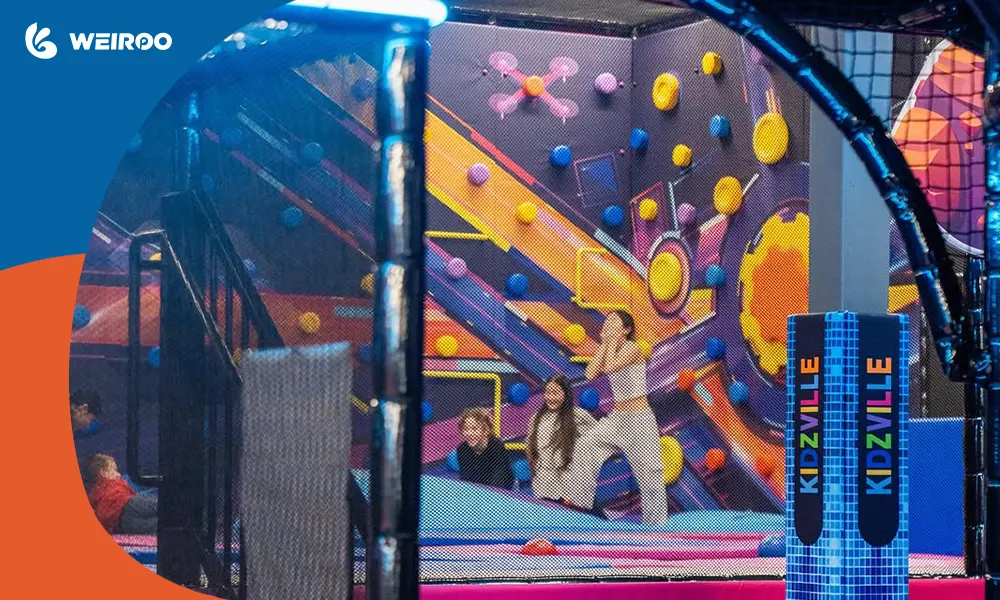
Amateurs think an indoor playground only makes money from front-door ticket sales. Professionals know that tickets only cover the overhead. The real profit comes from the “Up-sells.”
If you want to accelerate your ROI, focus heavily on Birthday Parties.
- Why Birthday Parties? Because they are economically immune to trends. Every child has a birthday every year. Parents are willing to spend $300 to $800 for a private party room, pizza, and zero cleanup stress. It is guaranteed, high-margin, predictable income booked weeks in advance.
- The F&B (Food & Beverage) Anchor: Parents get bored. If you don’t have a cafe serving good coffee and snacks, families will leave after 60 minutes. If you have a great cafe, they will stay for 3 hours, order lunch, and spend 50% more per visit.
4. Surviving the “Weekday Curse”
Your park will be packed on Saturday and Sunday. But what happens on a random Tuesday morning in November? The rent is still due, but the kids are in school.
To achieve a fast ROI, you must master weekday marketing. Here are the top strategies used by our most successful clients:
- School & Daycare Field Trips: Partner with local schools to host morning physical education sessions or reward trips. Give them a massive group discount—$10 a kid is better than an empty building.
- Weekday Birthday Marketing: Kids’ birthdays don’t magically only fall on weekends. Offer aggressive discounts or “Pizza Included” packages for parties booked on Monday-Thursday evenings.
- The “Family Dinner” Strategy: If you have a solid F&B section, market your venue as a dinner destination. Parents can eat a hot meal in peace while the kids burn off energy before bed.
5. The True Break-Even Timeline (From 2 Months to 2 Years)
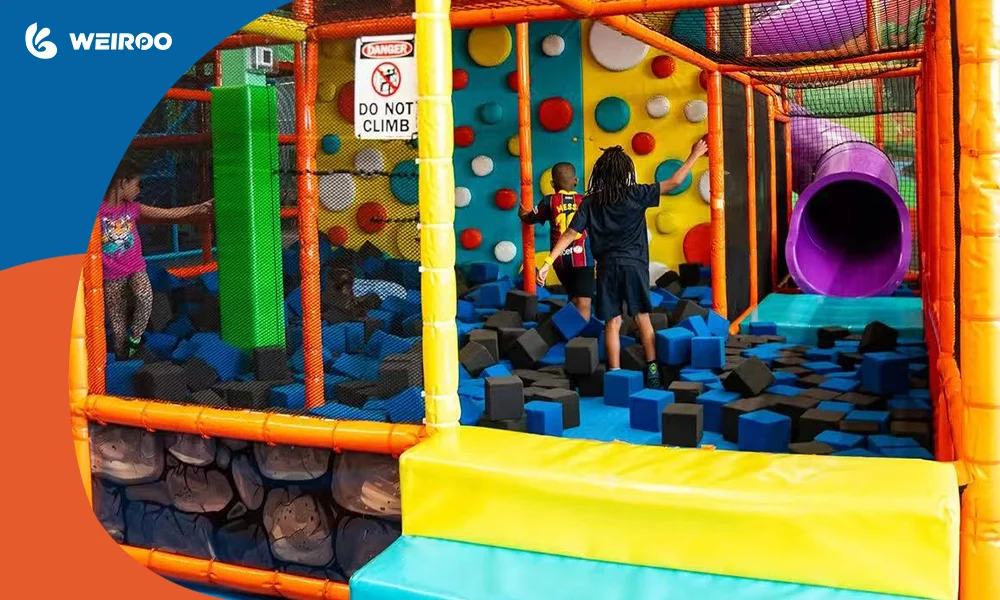
So, how long does it take to break even?
I will be completely honest: I have seen a client break even in a staggering 2 months. But let me be clear—that is an absolute anomaly. It was a perfect storm of a premium location, zero local competition, brilliant pre-sale marketing, and a massive holiday launch.
The Realistic Expectation: For a well-managed 500 to 1,000 sqm commercial playground, a healthy and realistic break-even point is between 12 to 18 months.
Because local taxes, labor wages, and ticket prices vary wildly around the world, you cannot guess this number. You must calculate it.
👉 Stop guessing. Use our professional Playground Business ROI Calculator to input your specific rent, ticket price, and capacity to see your exact timeline.
6. The 5-Year Lifespan: Do I Need to Constantly Buy New Stuff?
A common fear is that kids will get bored after year one, forcing the owner to spend another $100,000 on new equipment.
The Truth: The indoor amusement industry is highly mature. If you partner with a top-tier factory to design a park with diverse play zones (Ninja courses, interactive trampolines, giant slides), your layout will not become outdated for at least 5 years.
To maintain your ROI, you do not need to buy a whole new playground. You just need strict, daily maintenance. Keep the netting tight, wash the ball pit, and replace torn PVC vinyl immediately. A clean, safe park retains customers infinitely better than a dirty park with a new gimmick.
Conclusion: Business is Math, Not Emotion
Opening an indoor playground is one of the most rewarding businesses in the world, but it requires cold, hard math.
Control your rent (under 30%), calculate your safe capacity (3 sqm per child), push your birthday party packages, and utilize our ROI calculator to map your exact path to profitability.
Ready to design a park optimized for maximum ROI? Send us your floor plan today, and let’s build a business model, not just a playground.
FAQ: Financial & Geo-Specific ROI Questions
Q1: How do local minimum wage laws impact my ROI?
Labor is your second highest cost after rent. Geography dictates this heavily. Expert Insight: If you are operating in California (USA) or Australia, high minimum wages mean you must design your park for low staff oversight. This means relying on secure, self-contained play structures and electronic waiver kiosks. If you are operating in the Middle East or Southeast Asia where labor is cheaper, you can afford a higher staff-to-child ratio for premium customer service. Always factor local labor laws into our ROI calculator.
Q2: Should I lease or buy the playground equipment to help my cash flow?
We are a direct manufacturer, meaning we require standard payment terms (Deposit/Balance), but local financing is highly recommended. Expert Insight: Most of our successful US and UK clients do not pay out of pocket. They use local small business loans (like SBA loans in the US) or equipment financing companies. Because our equipment has a proven lifespan of 5+ years and holds intrinsic value, local banks are often willing to finance the initial purchase, allowing you to keep your liquid cash for marketing and rent buffers.
Q3: Are there hidden operational costs that hurt the break-even timeline?
Yes. The biggest silent killer is the local utility bill (HVAC). Expert Insight: If your venue is in a hot climate (Texas, Dubai, Singapore), the cost to air-condition a massive warehouse filled with 200 sweating kids is astronomical. We have seen clients severely underestimate their summer electricity bills, which eats directly into their 30% rent/overhead allowance. Always ask the previous tenant for their average utility bills before signing the lease.
Q4: How much of my initial budget should I save for “Pre-Opening Marketing”?
Reserve at least 5% to 8% of your total capital for the month before you open. Expert Insight: You cannot just open the doors and pray people show up. You need to sell hundreds of pre-booked Birthday Parties before the equipment is even fully installed. Spend money on local Facebook/Instagram geo-targeted ads, local mom-group sponsorships, and school flyers while the container is still on the ocean.